


Artificial intelligence (AI) is rapidly becoming more powerful and pervasive, but this growth comes at a steep energy cost. Data centers already consume around 1.5% of global energy, and that number is rising by 12% annually. As AI models like ChatGPT become more complex, the demand for computing power—and electricity—will only increase. Researchers are now exploring a radical alternative: optical computers that use light instead of electricity to perform calculations.
The Promise of Optical Computing
For decades, optical computing has remained largely theoretical. The challenge lies in mimicking the logic gates of traditional computers with photons rather than electrons. Unlike electricity, light naturally travels in straight lines, making it difficult to create the nonlinear functions necessary for complex data processing.
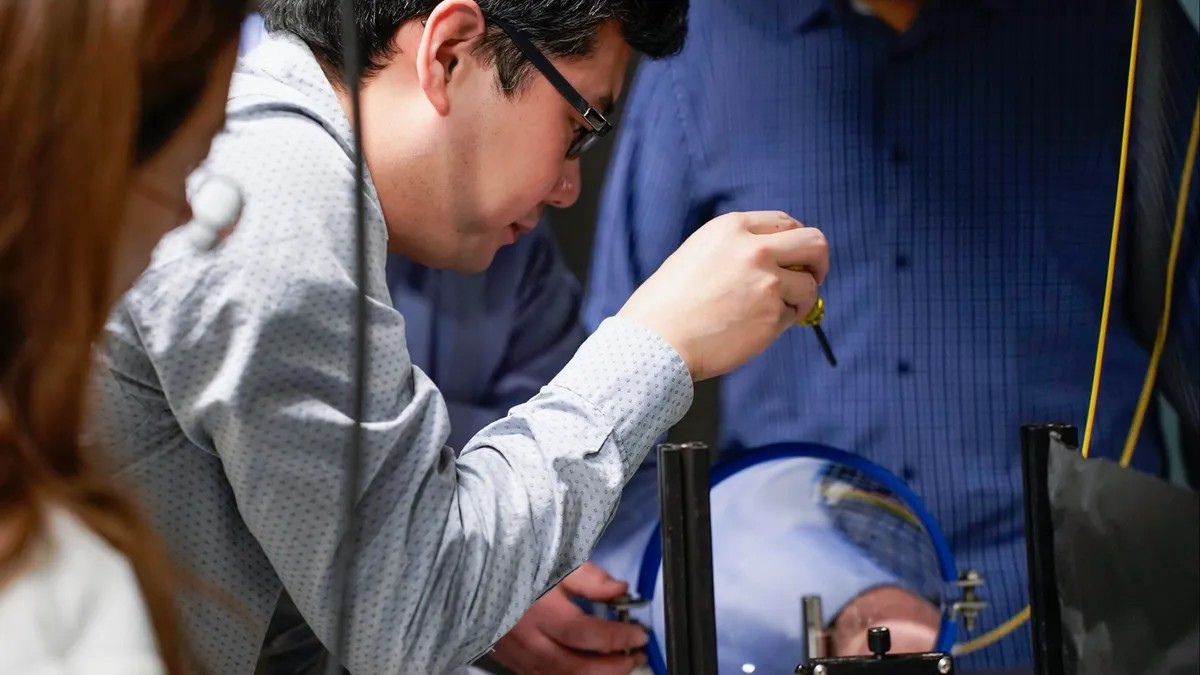
A team at Penn State recently published research in Science Advances outlining a potential breakthrough. Their approach uses an “infinity mirror” setup—a loop of optical elements—to encode data into light beams, creating the necessary nonlinear behavior without high-power lasers or exotic materials. The system captures light patterns with a microscopic camera, effectively performing AI-relevant calculations.
Why This Matters
The current trajectory of AI energy consumption is unsustainable. Data center expansion is already straining power grids, and the environmental impact of electricity generation is significant. If AI is to scale responsibly, we need more efficient computing methods.
Optical computing offers a compelling path forward. Unlike electrical circuits, light-based systems could theoretically operate at much lower power levels while achieving comparable or even superior performance.
“The key takeaway is that a carefully designed optical structure can produce the nonlinear input–output behavior AI needs without relying on strong nonlinear materials or high-power lasers,” explains Xingjie Ni, a Penn State engineering professor.
The Path Forward: Hybrid Systems
Despite the progress, optical computers are not poised to replace traditional silicon chips anytime soon. The technology faces manufacturing hurdles and requires further refinement before practical deployment. Experts predict that industry-ready prototypes are still two to five years away, contingent on funding and specific applications.
The most likely scenario is a hybrid approach : integrating optical chips alongside existing GPUs to accelerate computationally intensive AI tasks. This would allow electronics to handle general-purpose processing while optics tackle energy-hungry workloads.
Francesca Parmigiani of Microsoft Research notes that optical computing “has the potential to efficiently perform vastly more operations in parallel and at significantly higher speeds than conventional digital hardware.” Chene Tradonsky, co-founder of LightSolver, emphasizes that energy efficiency is no longer secondary in AI development.
Ultimately, optical computing represents a crucial step toward a more sustainable future for AI. While challenges remain, the potential rewards—reduced energy consumption, faster processing, and lower costs—make it a field worth watching.


