




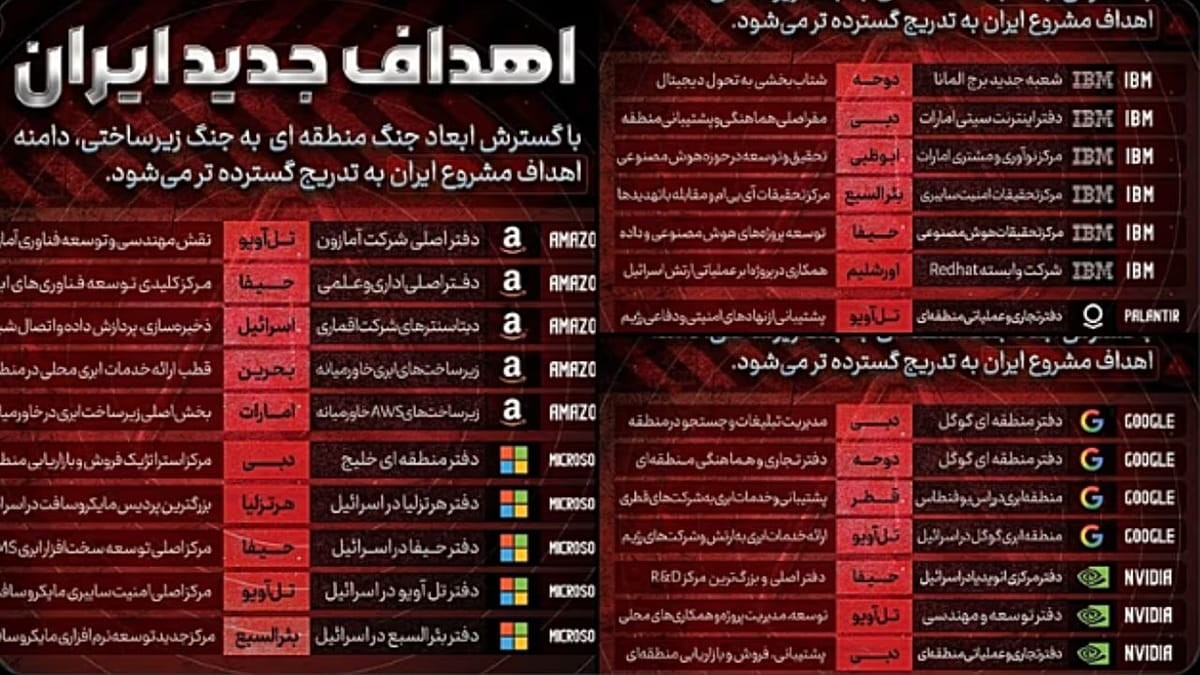
Iran has publicly threatened to target assets belonging to major American technology companies – including Amazon, Google, Microsoft, NVIDIA, IBM, and Palantir – across the Middle East, escalating tensions with the United States. The warning, issued via the Iranian news agency Tasnim (linked to the Islamic Revolutionary Guard Corps), identifies approximately 30 locations as potential targets, labeling them “enemy technology infrastructure.”
Rising Stakes in Regional Conflict
This threat is not isolated; it follows recent attacks on data centers in the UAE and Bahrain, claimed by the IRGC. These attacks targeted facilities allegedly supporting military and intelligence operations, signaling a shift toward directly confronting American tech presence in the region. The timing is critical: as broader geopolitical conflicts intensify, Iran appears willing to weaponize cyber and physical attacks against key economic interests.
Specific Targets: Why These Companies?
The listed targets are strategically chosen. Many are involved in AI development and cloud computing services, crucial for modern warfare and intelligence gathering. For example:
- Palantir offices in Tel Aviv, a leading defense technology firm.
- Amazon and Microsoft facilities in Tel Aviv and Dubai, providing critical cloud infrastructure.
- NVIDIA’s engineering centers, key to AI and military applications.
The Iranian statement explicitly accuses these companies of aiding “military entities,” particularly citing the controversial Project Nimbus – a $1.2 billion contract awarded to Amazon and Google by Israel in 2021. According to a UN report, this project gives Israel sweeping access to advanced cloud and AI technologies.
The UN Report and Broader Implications
A 2023 UN report by rapporteur Francesca Albanese alleges that these companies – including IBM – have trained Israeli military and intelligence personnel, and that Palantir may have supplied predictive policing technology used in Palestine. While Oracle was not directly mentioned, reports suggest pro-Israel bias within the company’s internal culture.
The implications are clear: Iran views these tech firms not as neutral businesses, but as integral parts of a broader network supporting its adversaries. This escalation marks a significant shift, where economic infrastructure is now explicitly considered a legitimate target in regional conflicts.
What Happens Next?
The immediate reactions from the targeted companies remain unconfirmed, but the Iranian threat should be taken seriously. The IRGC has demonstrated willingness to act on its claims, and further escalation could disrupt critical tech services across the Middle East. The situation underscores the increasing convergence of cyber warfare, physical attacks, and geopolitical tensions in the modern era.