




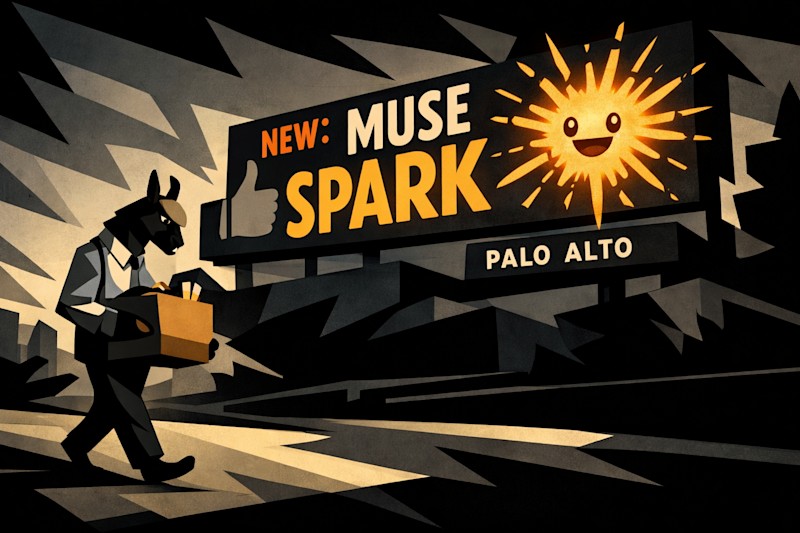
Meta has officially broken its year-long silence in the frontier AI race with the launch of Muse Spark. This new model represents a radical strategic shift for the company: moving away from its identity as the champion of open-source models toward a high-performance, proprietary ecosystem.
The release follows a period of turbulence for Meta. After the mixed reception of the Llama 4 series, which faced criticism regarding benchmark accuracy, CEO Mark Zuckerberg overhauled the company’s AI operations in mid-2025. This led to the creation of Meta Superintelligence Labs (MSL), led by Chief AI Officer Alexandr Wang. Muse Spark is the first major product from this new division.
A Leap in Reasoning and Vision
Unlike previous models that “stitched” text and vision capabilities together, Muse Spark is a natively multimodal model. It was built from the ground up to integrate visual data into its core reasoning process. This enables a feature Meta calls “visual chain of thought,” allowing the AI to analyze dynamic environments in real-time—such as identifying parts of a machine or providing feedback on a user’s physical form during a workout.
Key technical highlights include:
– “Contemplating” Mode: A system that orchestrates multiple sub-agents to reason in parallel, allowing Muse Spark to compete with elite models like OpenAI’s GPT-5.4 Pro and Google’s Gemini.
3. Thought Compression: A breakthrough in efficiency. Meta reports that Muse Spark achieves frontier-level intelligence using significantly less compute than its predecessor, Llama 4 Maverick. By penalizing excessive “thinking time” during reinforcement learning, the model is forced to solve complex problems with fewer reasoning tokens.
Benchmarks: Returning to the Global Top 5
Data from independent auditing firm Artificial Analysis suggests that Muse Spark is not just a minor upgrade, but a fundamental re-entry into the world’s most elite AI tier.
According to the Artificial Analysis Intelligence Index v4.0, Muse Spark earned a score of 52, a massive leap from Llama 4 Maverick’s score of 18. This places it within striking distance of the industry leaders:
– Gemini 3.1 Pro Preview: 57
– GPT-5.4: 57
– Claude Opus 4.6: 53
Muse Spark shows particular dominance in multimodal reasoning and healthcare. In “figure understanding” (CharXiv), it outperformed Claude and GPT. Furthermore, thanks to training data curated alongside 1,000 physicians, the model achieved a massive lead in medical benchmarks like HealthBench Hard, significantly outperforming its primary competitors.
From Information Library to Personal Agent
Meta is not just releasing a model; it is deploying an experience. Muse Spark is being integrated across Meta’s ecosystem to act as a “digital extension of the self.”
- Shopping Mode: Leveraging Instagram and Threads, the AI can identify brands and styles in posts to provide personalized shopping recommendations.
- Health Reasoning: The model can analyze nutritional content from photos or provide health-related insights based on specific dietary needs.
- Interactive UI: The AI can generate real-time digital content, such as turning a photo into a playable game or a tutorial.
The Great Divide: Open Source vs. Proprietary
The most controversial aspect of this launch is that Muse Spark is proprietary. It is currently confined to the Meta AI app, website, and a private API for select users.
This marks a sharp departure from the “Llama era,” where Meta provided the “LAMP stack” for the AI world—open-weight models that allowed developers to self-host and save billions in costs. The move has caused friction within the developer community, particularly on platforms like Reddit, where many relied on Llama’s open nature.
Alexandr Wang has attempted to ease these concerns, stating that while Muse Spark is proprietary, Meta plans to open-source future, larger versions of the Muse family. However, for now, the company is prioritizing the race for “personal superintelligence” over the democratization of its most advanced tech.
The Bottom Line: With Muse Spark, Meta has transitioned from being the infrastructure provider for the AI masses to a direct competitor for the world’s most advanced proprietary intelligence. While the company remains committed to keeping current Llama models open-source, its future focus has clearly shifted toward closed, high-reasoning agentic systems.