



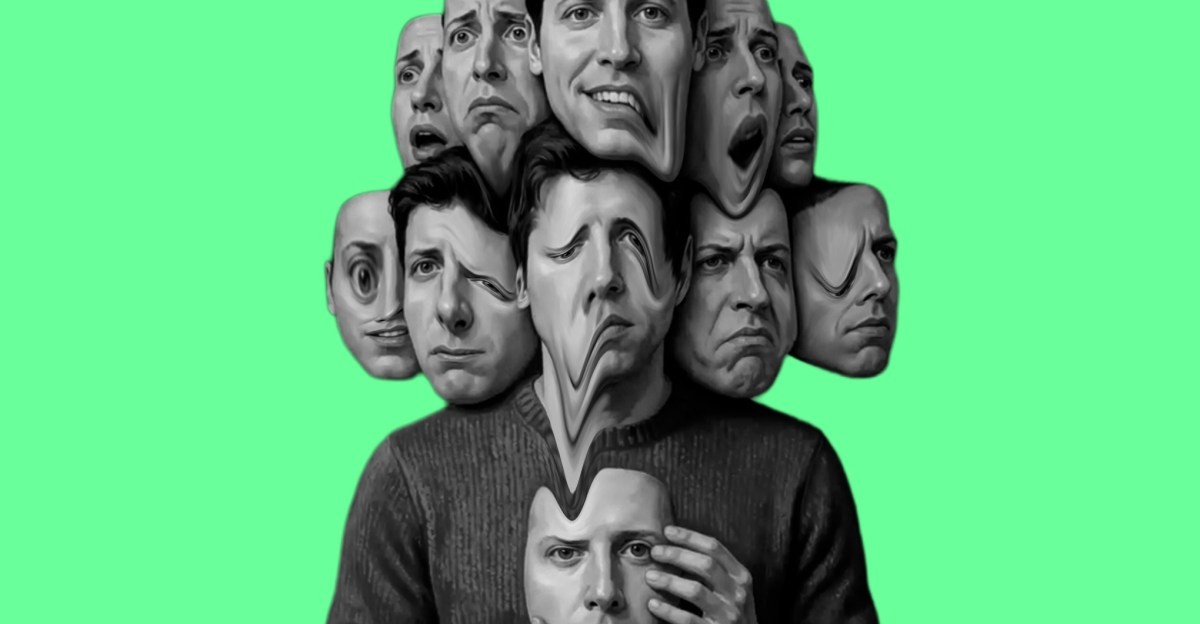
The recent profile of OpenAI CEO Sam Altman in The New Yorker has sparked a debate that goes far beyond mere aesthetics. The accompanying illustration, created by mixed-media artist David Szauder, features a cluster of disembodied, shifting faces hovering around Altman. While the piece is explicitly labeled as “Generated using A.I.,” its presence in one of the world’s most prestigious magazines raises profound questions about the future of creative intention, the value of human labor, and the “ensloppification” of modern media.
The Process vs. The Product
Unlike the mindless “slop” often associated with generative AI—low-effort, text-prompted images that flood social media—Szauder’s approach is deeply technical and intentional. He does not simply type a prompt and accept the first result. Instead, his process involves:
- Custom Coding: Developing his own software to generate images based on specific archival materials.
- Hybrid Workflows: Combining classical editing (such as Photoshop) with AI-based refinements.
- Human Iteration: Moving through dozens of sketches and manual corrections to shape facial expressions and lighting.
Szauder maintains a vital philosophy: “I strongly believe that even in the age of AI, an image must first be formed in the human mind, not in the machine.”
However, even with this high level of human involvement, the final product faces criticism. Critics argue that the reliance on AI’s inherent “uncanniness”—that unsettling, slightly off-putting quality—becomes a crutch. Rather than using art to provide a new perspective, the image relies on the mere vibe of AI to tell its story, potentially missing a deeper level of stylistic commentary.
The Existential Threat to Illustrators
The adoption of AI by major publications occurs against a backdrop of extreme economic precarity for freelance artists. The industry is currently facing several systemic pressures:
- Job Displacement: As newsrooms look to cut costs, illustration budgets are often the first to be slashed, with AI being positioned as a cheaper alternative.
- The Devaluation of Authorship: Under current US Copyright Office guidance, images created purely through text prompts cannot be copyrighted because they lack “human authorship.” This creates a legal and professional vacuum for creators.
- Economic Fragility: Freelance illustration is a highly atomized field, making it nearly impossible for artists to unionize or collectively bargain against declining rates and technological disruption.
Why This Matters for Media Integrity
When a publication like The New Yorker integrates generative AI, it does more than just change its visual language; it risks normalizing a technology that many see as the antithesis of fine art.
There is a fundamental difference between an artist’s eye—informed by a lifetime of taste and intent—and an algorithm’s output. An artist translates a vision into a tangible reality through a rigorous process; an AI merely interprets a prompt. When the “process” is stripped away, the connection between the creator’s intent and the viewer’s experience is weakened.
While Szauder’s work is a sophisticated attempt to use AI as a tool rather than a replacement, the move remains a “slippery slope.” By inviting these tools into the editorial fold, even in a controlled, artistic manner, prestigious outlets may be inadvertently legitimizing a medium that threatens the very livelihood of the professionals they employ.
Conclusion
The use of AI in high-end editorial illustration represents a complex middle ground: it is neither pure “slop” nor traditional art. While it offers new ways to express complex ideas, it simultaneously risks devaluing the human process and accelerating the economic instability of the creative profession.