



Computers don’t sleep. They just stare at data until it starts looking like something else entirely.
While we are offline, our machines are busy reinterpreting old files and spitting out weird new material. The engine behind this? Google Deep Dream. It’s a program that hunts for patterns in digital pictures, alters them, and serves up the results for us to judge. You can get silly. You can get artistic. Or you can get nightmarish. It depends on what you feed it and what parameters Google employees set.
The only real way to grasp what Deep Dream does is to try it. Google opened up its servers to the public. The goal was to understand how the program classifies and indexes images. You upload a photo. Seconds later, you get a fantastical rendering based on that original shot.
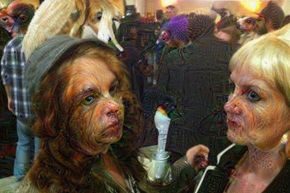
The output is a bizarre hybrid. Imagine if Salvador Dali, Hieronymus Bosch, and Vincent van Gogh hosted a wild painting party that lasted all night. That’s the vibe. Leaves turn into colorful swirls. Rocks become repetitive rectangles. Mountains dissolve into graceful highlighted lines.
An empty landscape? Deep Dream fills it. Pagodas. Cars. Bridges. Human body parts. It sees animals. Lots of them.
Upload a portrait of Tom Cruise. The program will rework the creases and spaces into dog heads, fish, and other familiar creatures. These aren’t normal animals. They’re fantastical recreations crossed with an LSD-tinged kaleidoscope. They are eerily evocative. Often terrifying.
Google isn’t throwing raves. It isn’t feeding its servers hallucinogenic chemicals. It is guiding those servers to analyze images and then regurgitate them as new representations of our world.
How it works tells us something about how we build digital devices. It shows how machines digest the unimaginable amount of data in our tech-obsessed world.
Neurons in Bits

Computers are cold, inorganic machines. They don’t sleep. They certainly don’t dream. Or so we thought.
Deep Dream changed that perception. It wasn’t about giving a computer a subconscious. It was about exposing the sheer, bizarre complexity that emerges when you feed human-world data into increasingly tangled code.
Google’s developers didn’t start this as a art project. They built Deep Dream for the ImageNet Large Scale Visual Recognition Challenge. This contest began in 2010. Every year, dozens of teams race to build the best automatic image classifiers. The goal? To detect and sort millions of photos without human help. After each contest, the losers (and winners) tweak their algorithms. They try to do it faster. Better. More accurately.
Here’s the problem with that quest. Image recognition is largely absent from our standard internet toolkit. Search engines? They love keywords. Type “cat” and you get text results. Type “cat.jpg” and you might get a file. But ask a search engine to understand what’s in a photo? It struggles.
We tag our photos ourselves. “House.” “Tommy.” “Sunset.” We do this because computers can’t reliably parse visual clutter. Real life is messy. It’s not clean vectors. It’s noise. And until recently, machines treated that noise as garbage data.
Deep Dream was an attempt to fix that blindness.
How Deep Dream Works
The secret sauce? An artificial neural network (ANN).
This isn’t just code. It’s a system modeled after the human brain. Think about it. We have over 100 billion neurons. They fire impulses. They process sensory input. They help us recognize a face across a crowded room.
Deep Dream mimics this. It uses artificial neurons to filter data. It runs that data through layers. And layers. And layers. Again and again.
The Architecture of a Dream
For Deep Dream, the network typically has between 10 and 30 layers of these artificial neurons. That’s a lot of processing steps for one image.
The system doesn’t just “see” an image. It breaks it down. It looks for patterns. Edges. Curves. Textures. It refines its interpretation at each layer. The final output is an image. But not the original one.
The result is a hallucination.
You feed in a photo of a park. The computer sees trees. It sees grass. But because the neural network is hyper-tuned to find anything that looks like a known object, it starts amplifying features.
The grass becomes fur. The tree branches become legs. The sky becomes a giant eye.
Why It Matters for Visual Search
This isn’t just a trippy screensaver. It highlights a shift in how we process information.
For years, we’ve relied on metadata. We labeled our digital lives. But Deep Dream showed that machines could learn to interpret visual data without those labels.
“Deep Dream showed us that if you let a machine look hard enough, it will find patterns that aren’t there—or rather, it will find patterns that we don’t see.”
The computer isn’t dreaming in a human sense. It’s optimizing. It’s pushing pixels toward what it thinks belongs. And in doing so, it reveals the gaps in its own understanding.
If a machine can turn a bike into a creature made of bicycles,
Neural networks are not magic mirrors that just reflect data back at you. They don’t automatically start identifying patterns out of thin air. They require training. You have to feed them sets of data to use as reference points. Without that heavy lifting, they would just blindy sift through information, unable to make sense of any of it.
According to Google’s official blog, the training process relies on repetition and analysis. Let’s say you want to train an Artificial Neural Network (ANN) to identify a bicycle. You don’t just tell it “bicycle.” You show it millions of images of bicycles. You also specify, in computer code, what a bike actually looks like. Two wheels. A seat. Handlebars.
Then researchers turn the network loose to see what it finds. It will make errors. The program might return a series of images that include motorcycles and mopeds. When that happens, programmers tweak the code. They clarify to the computer that bicycles don’t have engines or exhaust systems. They run the program again. And again. They fine-tune the software until the results are satisfactory.
“The Deep Dream team realized that once a network can identify certain objects, it could then also recreate those objects on its own.”
The Deep Dream team noticed something interesting. Once a network can identify objects, it can reproduce them without further input. A network that knows a bicycle on sight can generate an image of a bicycle from scratch. The idea is that the network generates creative new imagery simply because it has the ability to classify and sort images.
It sounds impressive until you look at the output. Even after sifting through millions of bike pictures, computers make critical mistakes when generating their own images. The generated bikes might feature partial human hands on the handlebars. Or feet on the pedals. This happens because so many of the training images include people. The computer eventually can’t discern where the bike parts end and the human parts begin.
These kinds of mistakes happen for numerous reasons. Software engineers don’t fully understand every aspect of the neural networks they build. But knowing how they work helps you comprehend how these flaws occur.
The Architecture of Inceptionism
The artificial neurons in the network operate in stacks. Deep Dream may use as few as 10 layers or as many as 30. Each layer picks up on various details of an image. The initial layers detect basics like borders and edges. Another layer might identify specific colors and orientation.
Other layers look for specific shapes that resemble objects like a chair or a light bulb. The final layers react only to more sophisticated objects such as cars, leaves, or buildings.
Google’s developers call this process inceptionism. It refers to this particular neural network architecture. They even posted a public gallery to show examples of Deep Dream’s work. It’s a glimpse into how the machine sees.
Once the network has pinpointed various aspects of an image, any number of things can occur. With Deep Dream, Google decided to tell the network to make new images. It doesn’t just analyze. It creates.
Darkness on the Edge
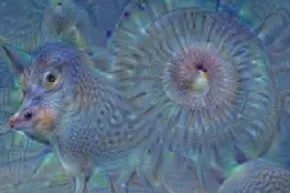
Google engineers didn’t just let Deep Dream pick which parts of an image to identify. They essentially told the computers to take those aspects of the picture and emphasize them.
If Deep Dream sees a dog shape in the fabric pattern on your couch, it accentuates the details of that dog.
Each layer adds more to the dog look. Fur. Eyes. The nose. What was once harmless paisley on your couch becomes a canine figure complete with teeth and eyes.
Deep Dream zooms in a bit with each iteration of its creation. It adds more and more complexity to the picture. Think dog within dog within dog.
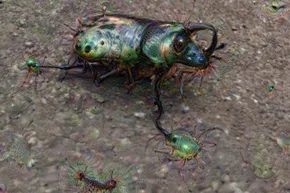
A feedback loop begins as Deep Dream over-interprets and overemphasizes every detail of a picture. A sky full of clouds morphs from an idyllic scene into one filled with space grasshoppers, psychedelic shapes and rainbow-colored cars. And dogs.
There is a reason for the overabundance of dogs in Deep Dream’s results. When developers selected a database to train this neural network, they picked one that included 120 dog subclasses, all expertly classified. So when Deep Dream goes off looking for details, it is simply overly likely to see puppy faces and paws everywhere it searches.
Deep Dream doesn’t even need a real image to create pictures. If you feed it a blank white image or one filled with static, it will still “see” parts of the image, using those as building blocks for weirder and weirder pictures.
It’s the program’s attempt to reveal meaning and form from otherwise formless data. That speaks to the idea behind the entire project — trying to find better ways to identify and contextualize the content of images strewn on computers all over the globe.
So can computers ever really dream? Are they getting too smart for their own good? Or is Deep Dream just a fanciful way for us to imagine the way our technology processes data?
It’s hard to know exactly what is in control of Deep Dream’s output. No one is specifically guiding the software to complete preprogrammed tasks. It’s taking some rather vague instructions (find details and accentuate them, over and over again) and completing the jobs without overt human guidance.
The resulting images are a representation of that work. Perhaps those representations are machine-created artwork. Maybe it’s a manifestation of digital dreams, born of silicon and circuitry. And maybe it’s the beginning of a kind of artificial intelligence that will make our computers less reliant on people.
You may fear the rise of sentient computers that take over the world. But for now, these kinds of projects are directly benefiting anyone who uses the Web. In the span of just a few years, image recognition has improved dramatically, helping people more quickly sift through images and graphics to find the information they need. At the current pace of advancement, you can expect major leaps in image recognition soon, in part thanks to Google’s dreaming computers.