




The Höchstleistungsrechenzentrum Stuttgart, or HLRS, has spent decades building the kind of computing muscle that makes normal hardware look like a toy. For a long time, the mandate was clear. This was a fortress for science. Universities and research institutes held the keys. They needed to simulate climate models, analyze protein structures, or crack codes that would take a laptop cluster a century to solve. The business world watched from the sidelines, mostly content to keep their spreadsheets running.
That dynamic is shifting. Fast.
Companies are waking up to a hard truth. The problems they face now are too complex for standard servers. Data volumes are exploding. The margin for error in manufacturing, finance, and logistics is shrinking to zero. HLRS is no longer just a university club. It is becoming an essential utility for the economy.
The New Demand For Raw Power
Why are enterprises suddenly knocking on the door of the Stuttgart supercomputer center? It isn’t about vanity metrics anymore. It is about survival.
Traditional IT infrastructure hits a wall when you try to model real-world chaos. You can simulate a car crash on a regular server. You can’t simulate the aerodynamic drag of an entire fleet of autonomous vehicles navigating a hurricane. You can’t optimize a global supply chain that is being disrupted by a port strike three continents away in real-time.
“Unternehmen werden künftig wohl häufiger auf so massive Rechenkapazitäten angewiesen sein.”
Translation: Companies will increasingly rely on such massive computing capacities in the future.
This isn’t a trend. It’s a structural shift. The gap between what businesses need to know and what they can compute with off-the-shelf tech is widening every year. HLRS bridges that gap. Their systems don’t just crunch numbers faster. They crunch them in ways that reveal patterns invisible to smaller machines.
From Lab Bench To Boardroom
The shift from pure academia to commercial application is messy. It shouldn’t be, but it is. Researchers speak in terms of petabytes and exaflops. CEOs speak in terms of ROI and market share. The languages don’t match well.
But the hardware doesn’t care about the language. It cares about throughput.
When a manufacturing firm wants to test a new engine design, they don’t need to build twelve physical prototypes anymore. They need a supercomputer that can run thousands of simulations simultaneously. The HLRS systems in Stuttgart can handle that load. They can process the data, find the failure points, and send the results back before the coffee in the breakroom goes cold.
For the business world, this means speed. Real speed. Not the “download in 4 seconds” speed of faster Wi-Fi, but the “solve a problem in an hour that used to take a month” speed. That is where the money is.
The Bottleneck Isn’t The Computer
You might think the only hurdle here is access. How do you get an appointment on a supercomputer? It’s not that simple. The architecture is alien to most IT departments. Writing code for a system like HLRS requires specialized knowledge. You can’t just throw legacy software at it and expect it to work.
This creates a new market. Consulting firms, specialized software vendors, and hybrid cloud providers are stepping in to help companies translate their business
Driving through a torrent downpour, a car wash, or a deep puddle shouldn’t leave your cabin flooded. It feels natural. It feels simple. But keeping the interior bone-dry isn’t luck. It is the result of massive engineering effort.
Seals on doors and windows require precise design. Underbody and engine bay covers must be shaped and bolted down so they don’t deform or loosen under pressure. Then there is the air conditioning. It needs air intakes. Those openings must be engineered to repel water entirely.
Porsche calls this entire complex set of requirements vehicle water management.
How simulation replaces real-world testing
For decades, this process relied on physical reality. You built the car. You sprayed it. You saw if it leaked.
Monika Wierse, who leads Methods & Model-Based System Engineering at Porsche, says that changed only recently. The shift came from suitable simulations. Now, engineers can solve water management problems using digital models. No actual raindrops fall.
“The water management was long heavily dependent on real tests,” says Wierse. “This only changed in recent years thanks to suitable simulations.”
The computer model is a detailed mirror of the real vehicle. Engineers cut corners inside the cabin. They skip the seats. But the exterior? That has to be precise.
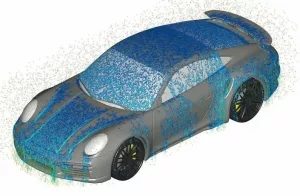
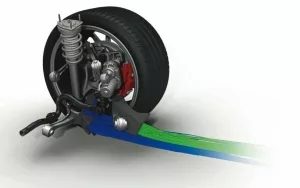
In the simulation, the digital car gets virtually drenched. It faces heavy rain. It drives through water half a meter deep. It speeds up to see how droplets slide along the bodywork toward the rear. This is just one slice of the water-related questions the engineering teams tackle.
The logic of the dip tank
The simulation even covers production steps. Before painting, car bodies go through massive immersion baths.
It sounds counterintuitive. In real life, you want rain to stay out. In the paint bath, you want the protective coating to get everywhere. Every angle. Every nook.
While rainwater shouldn’t penetrate the vehicle later, the situation in the immersion baths is exactly the opposite: The coating itself must reach the last corners of the body.
Simulating this fluid dynamics is hard. The math is heavy. The calculations are intense.
Porsche’s own servers can’t handle it. Not economically. It would be wasteful to keep such vast computing power in-house just for these tests.
Where the data goes
So where does the data go? Stuttgart-based Porsche uses the systems of the HLRS (High Performance Computing Center Stuttgart).
This isn’t a new relationship. Porsche has been using HLRS for simulations since the mid-1990s. They are part of the first wave of companies to outsource this heavy lifting.
Industrial users now account for about ten percent of the HLRS computer load. The trend is clear. In 2017, 25 companies ran simulations there per year. By 2021, that number jumped to 61.
The rain keeps falling in the digital world. The cars stay dry. The engineers keep calculating.

The Cost of Steel vs. Silicon
The deal isn’t just a win for carmakers. The High Performance Computing Center Stuttgart (HLRS) gets something too. It keeps its expertise sharp. It learns how to apply supercomputing power to real-world engineering headaches.
The automotive industry is the biggest user of this power. Think about prototyping. You need a physical car to know if it works. But building that car is slow. It is expensive. You can only build a prototype when every single component is already specified. If you miss a detail? You start over. That burns money and time.
Monika Wierse from Porsche puts it simply. The strategy is clear: build as few physical prototypes as possible.
“We have the strategic directive to develop with as few physical prototypes as possible.”
Take the Taycan. The first all-electric model. Before a single steel sheet was stamped, it had driven laps around the Nürburgring Nordschleife virtually. Countless times. This allowed engineers to check the cooling loop for the high-voltage battery and electric motors long before reality. They could see if it would handle extreme demands. Simulation finds the best solution even when requirements contradict each other.
Aerodynamics, Noise, and Crashes
Regular company servers handle simple tasks. But some jobs need a supercomputer. The HLRS machines. These handle water management. Aerodynamics. Aeroacoustics. And crash testing.
Aerodynamics matters for fuel consumption. It dictates handling. It defines comfort. Aeroacoustics? That is the noise inside when you roll down the window or open the sunroof. Virtual crash tests are far cheaper than smashing real cars.
The precision has changed the game. Wierse notes that virtual tests now reach millimeter-level resolution. Engineers can see if a glued seam tears apart. They can check if a welding spot holds.
To do this, you need a virtual model. But a supercomputer does not work like your laptop. A PC processes instructions sequentially. A supercomputer works in high-degree parallel. It breaks huge problems into smaller pieces and solves them all at once.
Think about the hardware. A smartphone or PC has a low, single- or double-digit number of processor cores. The HLRS supercomputers have hundreds of thousands of cores. They are built for parallel processing.
Breaking Down the Beast
This hardware difference changes how engineers build models. The virtual car must be sliced into sensible sections. These sections must exchange physically relevant data. Temperatures. Forces. Deformation. Vibration properties.
You split the model so the calculations run efficiently in parallel.
The outer shell consists of millions of 2D surfaces. They wrap around the 3D shape of the car. We are talking numbers far exceeding ten million faces. The model also ingests material data. Density. Tensile strength. Experimentally determined values. Like how a specific component vibrates.
It is a massive effort. But the result is a car that works before it exists. A car that is cheaper to develop. And safer. The question remains: how much more can we push before physics itself becomes the bottleneck?
The hidden cost of virtual water
Getting a supercomputer to spit out answers faster than conventional rigs isn’t just about throwing more power at the problem. It requires parallel computing algorithms that are perfectly tuned to the hardware. If the code isn’t adapted to the paradigm, the massive parallel infrastructure just sits there, idle.
Once the prep work is done, launching the actual simulation is boring. No Porsche engineer needs to fly to the HLRS in Stuttgart. A click from any dev machine starts the job. Results come back automatically.
“We never called it that, but in IT terms, this is Cloud Computing,” Wierse explains. “Direct, secure, automated transfer.”
Five seconds of rain, two days of crunch
The math behind Porsche’s water management simulations reveals the sheer scale of high-performance computing. To simulate heavy rain across the whole vehicle, the system used 256 CPU cores. The rain lasted only five seconds in the virtual world. The real-time compute time? 53 hours.
Driving through a 15-centimeter deep puddle at 30 km/h took two virtual seconds. That required 512 cores working for 105 hours straight.
These numbers are intimidating. Most companies hesitate.
HLRS CEO Bastian Koller knows the hesitation. First-time users worry about costs. They worry about data security. They worry about support quality.
The solution isn’t a sales pitch. It’s an engineering conversation.
No minimums, no contracts
The goal of the initial consultation isn’t signing a contract. It’s scoping the problem. Engineers need to see if existing simulation algorithms can even be parallelized for supercomputers.
There are no minimum usage quotas. You don’t pay for reserved capacity.
“Only what is actually used gets billed,” Koller says.
This model lowers the barrier to entry. Companies can test the waters without committing to a massive infrastructure overhaul. The risk shifts from fixed overhead to variable compute costs.
Is it worth it? For complex fluid dynamics, yes. For everything else? Probably not. The efficiency gains don’t scale linearly. They require specific, heavy-lift problems.
Breaking Barriers for SMEs in High-Performance Computing
Lowering the entry cost for high-performance computing (HPC) isn’t just for tech giants. The University of Stuttgart, which houses the HLRS, teamed up with the Karlsruhe Institute of Technology (KIT) in 2010 to launch SICOS BW. This entity actively reduces the initial hurdles for small and medium-sized enterprises (SMEs). They don’t just talk at industry events; they provide concrete business advice on funding programs and connect companies with necessary partners.
Take the EU-funded project “FF4EuroHPC,” which wrapped up in summer 2023. The HLRS coordinated this three-year effort involving multiple European supercomputing centers.
“In this framework, SMEs could apply for funding for a one-year business experiment… essentially a taste test for the topic.”
This approach lets companies dip their toes in without massive upfront risk. Beyond advisory roles, the HLRS runs a Supercomputing Academy for part-time professional development. They also operate specialized Solution Centers for specific industries: automotive, creative industries, and now medical technology.
Connecting Industry Players
These centers bring together users, researchers, and software providers. The logic is simple. All companies in a specific sector face similar computational challenges.
The Automotive Solution Center has been running since 2010. It focuses on five key areas:
– Vehicle propulsion
– Vehicle structure
– Vehicle physics
– Automation and connectivity
– Numerics and digitalization
The network is tight. Nearly 50 members belong to this center, including heavyweights like Audi, BMW, and Porsche. This proximity has already sparked pre-competitive collaborations in joint projects.
Real-World Use Cases
The list of industries using HLRS systems is expanding rapidly. Consider an aerospace and drive technology specialist manufacturing ventilators for climate control. Their internal computing power hit a wall. Simulations required such high spatial resolution that only identifying pressure fluctuations and turbulence could predict noise levels detectable by the human ear. HLRS resources solved this.
An engineering firm specializing in fire safety also utilized Stuttgart’s computing power. Designing for special structures like shopping malls often clashes with building codes. To bypass rigid regulations, they used alternative safety assessments via fire simulations. This requires calculating every second of a fire event in tiny time intervals. What would take their internal systems weeks took less time on the HLRS grid.
Elevator manufacturer TK Elevator used the same infrastructure for a new elevator concept. They simulated key functions to analyze ride noise and vibrations. The HLRS team even enabled a virtual reality visualization of the elevator design process.
Beyond Traditional Simulation
HLRS Managing Director Koller predicts many more companies will rely on supercomputers soon. The definition of high-performance computing is shifting.
“For a long time, HPC equated to simulations. But that is changing.”
Today, Big Data analysis and AI algorithms drive intense computational demands. Supercomputers are essential here too. The HLRS has already upgraded its systems to handle these specific workloads. This technical shift supports companies currently exploring data science and artificial intelligence.
This article is part of a special publication in cooperation with the High Performance Computing Center Stuttgart (HLRS). Here you can download the full edition of Wissenschaft extra.