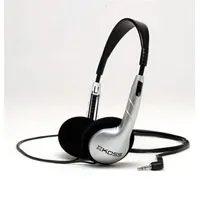
Dynamic drivers work in most headphones on the market. But before you worry about the internal technology, you need to choose a form factor. The design of the headphones determines everything from noise isolation to comfort.
Supra-aural headphones, often referred to as on-ear models, rest lightly and directly over the cartilage of the ear. In most consumer situations, think of them as open or open-air designs. The ear cups are usually softly padded. They can be rotated freely and thus adapt to the shape of the head. This helps reduce pressure points during long listening sessions.
There is a compromise in this design. Because they sit on the ear and don’t surround it, the noise leaks out. People nearby can hear your music. At the same time, external sounds penetrate. You are never truly isolated. This is important if you travel on a noisy train or work in an open office.
Compromise: seal vs. comfort
The characteristic feature of circumaural headphones is that they cover your ears completely. Also called “around-the-ear designs,” these closed cans form a full circle around the ear. This physical seal does two things immediately: it locks sound in and noise out. You get isolation without active electronics, and your playlist no longer leaks into the room.
But there is a price.
The materials required to maintain this airtight barrier add weight. You feel it on your head. And because they retain heat on the skin, long listening sessions can become a sweaty ordeal. They are durable, yes. But comfort? This is a variable.
In-ear precision
In-ear monitors and consumer earbuds belong to a completely different category. They split into two different camps.
First, you have a traditional earbud. It sits in the outer ear. No seal. No isolation. Sound projection only.
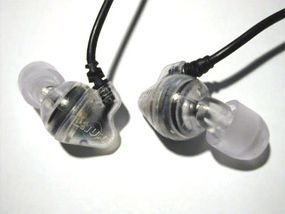
Then there are the canal headphones. These are the heavy lifters. They bypass the outer ear and sit deep in the ear canal, creating an airtight plug. Think of them as acoustic earplugs with drivers.
Why musicians choose Canal Fit
The sound quality of in-ear options depends a lot on the fit. A loose seal means the bass leaks and the highs get muddy. A tight seal? This is where the magic happens.
This is why professional musicians often use canal-style monitors. They don’t just want to hear music; they need to hear everything clearly, even through a screaming guitar amp. The airtight fit provides the acoustic isolation needed for stage monitoring. It’s not about comfort. It’s about fidelity.
If you’re looking for circumaural headphones for travel, the isolation is second to none. However, if you need clarity without weight, well-fitting canal headphones may be the only option that provides the clarity you need.
Which seal is better for your workflow? The heavy comfort of a cup or the intrusive precision of a plug? You usually keep it in your ear for more than twenty minutes.

Antiacoustic physics
You thought noise cancellation was a form of acoustic magic. This is not true. It’s just basic wave mechanics. A particularly destructive disorder.
All sounds are pressure waves. High and low. Compression and thinning in air. Something special happens when two identical waves meet. When the crests of one wave line up with the troughs of another wave, they cancel each other out. result? silence. At least the volume is significantly reduced.
Active noise canceling (ANC) headphones use this principle. You don’t block sound by mummifying your head with foam. They fight with sound.
How the circuit works
This process happens faster than you can blink an eye. The distribution order is as follows:
- Detection: The small external microphone in the ear cup monitors the surrounding noise. Wind, aircraft engine and HVAC system noise.
- Analysis: Built-in Digital Signal Processor (DSP). Analyze the frequency and amplitude of incoming noise in real time. This happens in a few milliseconds.
- Inversion: The processor produces a new sound wave that is the exact opposite of the noise. If the noise is a positive pressure wave, the headphones produce a negative pressure wave.
- Playback: The headphone speaker plays this anti-noise signal along with the music.
“Anti-noise waves meet and collide with external noise waves. Positive pressure and negative pressure cancel each other out. The sound is reduced.”
For this reason, ANC works best with smooth low-frequency sounds. aircraft engine. The train screams. The office air conditioner hums. All this is predictable. Easy to model and translate.
Protects against sudden high-frequency noise. the baby cries The door slams shut. discourse. These changes happen very quickly. The system can’t keep up. Latency is too high. Calculations cannot be made in time to remove the waves before they reach the eardrum.
Shuffle, feed forward, feedback
Not all ANCs are created equal. Architecture matters.
Feedforward ANC places the microphone outside the ear cup. You hear the noise before it arrives. question? You don’t hear how the sound actually affects the shape of the earcups or the head. Cancellation is not complete. This is a best guess based on external information.
Feedback ANC Place the microphone inside the ear cup, close to the driver. Hear what you really hear. The system can adjust the anti-noise signal based on the missing residual noise. More specifically. But it can be unstable. If the feedback loop is too strong, whistling or vibration may occur.
Hybrid ANC uses both. External microphones pick up a wide range of noise. The built-in microphone enables fine-tuning of the reverse. This is the gold standard for most quality headphones today. Sony, Bose, Apple – they all have hybrid systems in their top models. The result is a deeper silence. The cancellation frequency bandwidth widens.
Battery tax
This huge computational effort is expensive. Real-time audio processing requires power. ANC is not free. It will drain your battery.
Turn off ANC and you might get 30 hours of playback time. When it is on, it can fall