
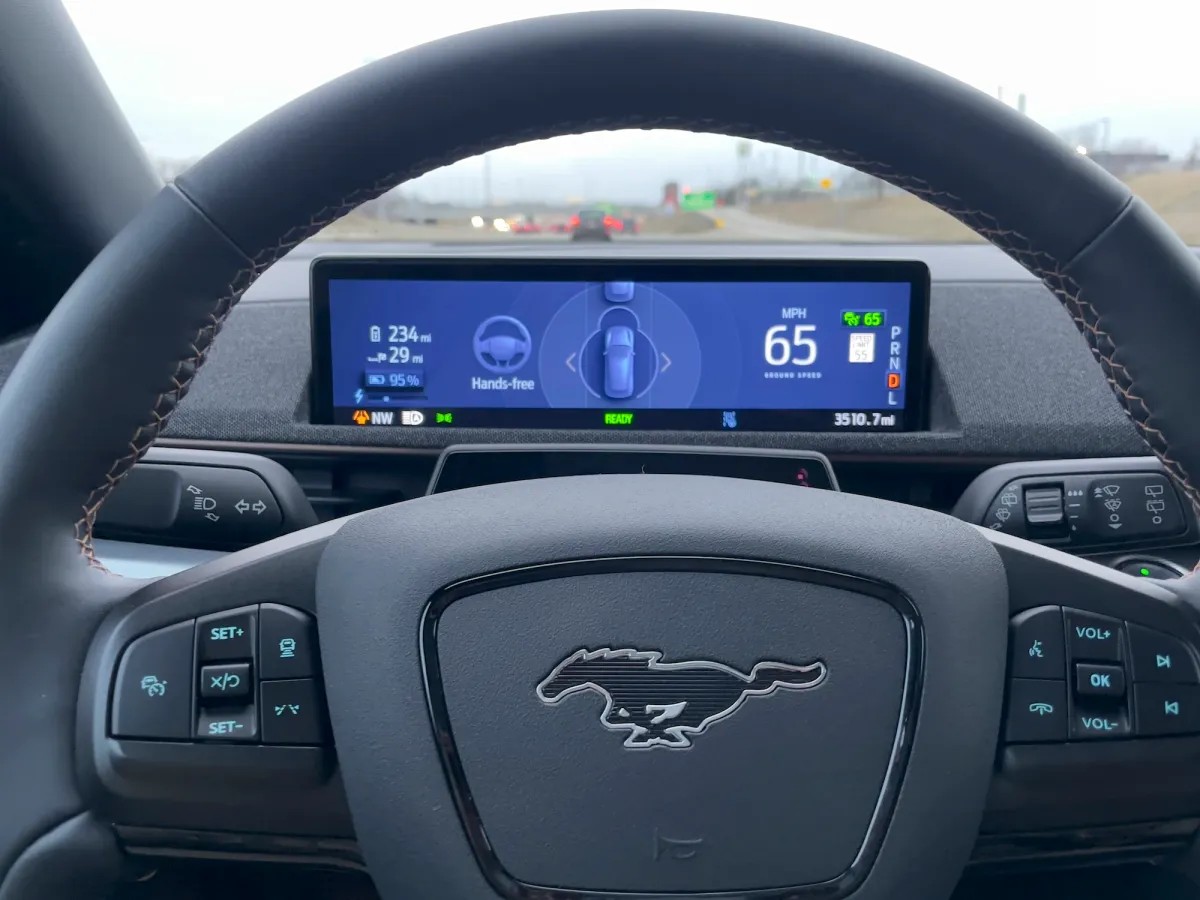
Two fatal crashes in 2024 involving Ford’s BlueCruise hands-free driving system underscore the critical need for driver attention even with advanced driver-assistance technology. New findings released by the National Transportation Safety Board (NTSB) indicate that drivers in both incidents were likely distracted immediately before impact, raising serious questions about the effectiveness of current driver monitoring systems. The NTSB will hold a public hearing on March 31 to discuss these findings and formulate recommendations for Ford, though the agency’s role is investigative rather than regulatory.
Fatal Crash in San Antonio: Distraction at 74 MPH
The first crash occurred in February 2024 in Texas. A Ford Mustang Mach-E traveling at 74 miles per hour collided with a stationary Honda CR-V. Data from the vehicle’s driver-monitoring system revealed the driver was looking at the infotainment screen for five seconds before impact, glancing at the road only briefly. Despite receiving alerts to focus on driving, the driver did not brake. The Honda driver died, while the Ford driver sustained minor injuries. The driver claimed to be using the navigation system, potentially contributing to the distraction.
Philadelphia Crash: Intoxication and Possible System Weakness
The second fatal crash happened in March 2024 in Philadelphia. A driver under the influence of alcohol crashed a Mach-E into stopped vehicles at 72 miles per hour in a 45-mph construction zone, resulting in two fatalities. Although the driver-monitoring system registered the driver as looking at the road, a photograph taken seconds before impact suggests she was holding a phone above the steering wheel, potentially bypassing the system’s detection. This raises questions about the reliability of current driver-monitoring technology.
Ford’s Position and System Limitations
Ford maintains that BlueCruise is a “convenience feature” and not a crash avoidance system, requiring drivers to remain alert. The company also warns that its forward-collision warning (FCW) and automatic emergency braking (AEB) systems are “supplemental” and do not replace driver attention. Ford employees have acknowledged to the NTSB that current radar and camera-based systems may not reliably detect stationary objects at high speeds under certain conditions. No braking was applied in either crash.
Broader Trends and Concerns
These findings echo concerns raised in previous investigations into Tesla’s Autopilot and Full Self-Driving software, which also highlighted driver distraction as a contributing factor in accidents. The NTSB’s emphasis on over-reliance on technology, lack of policy prohibiting cell phone use, and infrastructure failures points to a systemic problem.
The NTSB investigation underscores the fact that advanced driver-assistance systems are not foolproof and that drivers must remain fully engaged behind the wheel. The upcoming hearing will likely focus on how automakers communicate the limitations of these systems and ensure proper usage, as well as how to improve driver-monitoring technology to prevent future tragedies.