




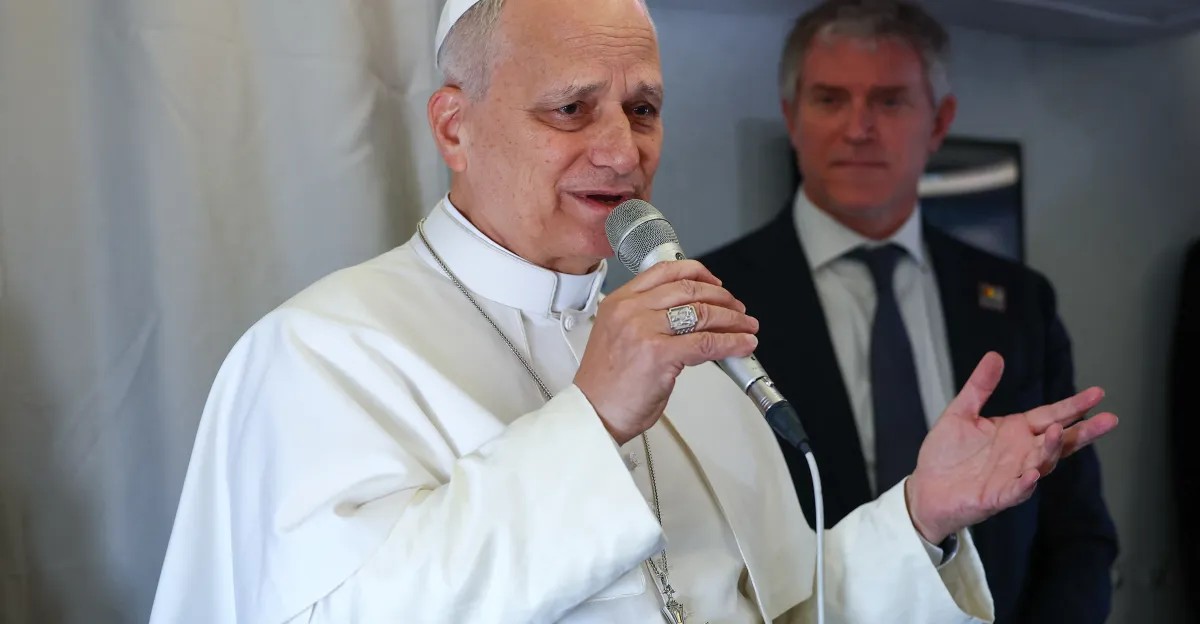
The ongoing friction between the White House and the Vatican has entered a volatile new phase. For several days, President Donald Trump and Vice President JD Vance have been locked in a public feud with Pope Leo XIV, centering on the administration’s military actions in Iran.
While the Trump administration has had contentious relationships with previous pontiffs, this latest confrontation is proving much harder to manage. Unlike previous clashes, the current standoff is not just a political spat; it is a theological and cultural battle that is dividing the Republican base.
Why This Conflict is Different
In previous years, Donald Trump’s disagreements with the papacy—most notably with Pope Francis—tended to alienate liberals while leaving his conservative core largely intact. However, the dynamics have shifted significantly under Pope Leo XIV for three primary reasons:
- Stronger Conservative Support: Leo has built deep credibility with traditionalist and orthodox Catholics, a demographic that felt sidelined under the previous papacy.
- Strategic Temperament: Unlike the often spontaneous and “off-the-cuff” Pope Francis, Leo is viewed as more temperate, deliberate, and disciplined in his communications.
- The Issue at Hand: The debate isn’t about social issues like immigration or abortion, but about war and military force —an area where even conservative Catholics are deeply divided.
The “Traditionalist” Advantage
The shift in political gravity can be traced back to Leo’s approach to the Church itself. Since his election, the Chicago-born Pope has leaned into the “aesthetics of authority” that appeal to traditionalists:
- Symbolic Restoration: He has reintroduced traditional liturgical elements, such as the use of Latin and more formal papal vestments (like the red mozzetta ).
- Reconciliation: He has moved to bridge the gap between progressive and traditionalist factions, specifically by showing openness toward the Traditional Latin Mass.
- Cultural Relevance: While Pope Francis was often criticized by the American right for being too aligned with secular liberals, Leo is presiding over a period of “cultural revival” in the U.S., where young Catholics and new converts are increasingly drawn to the Church’s traditional roots.
Because Leo has “earned” the trust of the American right through these religious gestures, his political critiques carry much more weight. When he speaks, his words are not easily dismissed as “liberal bias.”
A Divided Republican Base
The current friction is exacerbated by the specific topic of the dispute: the war in Iran.
While Republicans and Democrats have historically navigated disagreements with the Church on issues like abortion or immigration, the use of military force is a much more complex wedge issue. Recent polling suggests that many Catholic voters—even those who support Trump—express disapproval of the current conflict.
This creates a unique political vulnerability for the White House. When Trump attacks the Pope on Truth Social, or when Vance questions the Pope’s theological understanding, they aren’t just attacking a foreign leader; they are attacking a figure whom many of their own constituents view as a legitimate spiritual authority.
Lessons from the Past: Francis vs. Leo
The difference in how these two popes are perceived is stark:
Pope Francis was often seen as an “aggressor” by the American right. His 2016 comments regarding “building bridges instead of walls” were viewed as a direct political intervention, leading many GOP leaders to side firmly with Trump.
Pope Leo XIV has maintained a more moderate profile. By focusing on global issues like economic justice, AI, and human rights, he has built a reservoir of goodwill. This makes his decision to speak out on the Iran conflict feel like a principled stand rather than a political provocation.
Conclusion
The Trump administration is finding that attacking the papacy no longer offers a guaranteed political win. By clashing with a Pope who commands the respect of the religious right, the White House has entered a high-stakes confrontation that threatens to alienate its own most loyal supporters.