





The year was 1997. DVD technology finally arrived in homes everywhere, dragging digital sound and video out of the lab and into the living room. It changed how we watched movies. But that revolution was just the warmup.
In 2006, the industry prepared for another shift. The Blu-ray Disc (BD ) entered the scene. It promised to handle high-definition video and audio with ease. Photos. Data. Massive files. Standard DVDs simply could not keep up.
HowStuffWorks breaks down the mechanics behind Blu-ray. We also look at how this format compares to other digital video contenders. The goal is simple. Understand why the storage jump mattered.
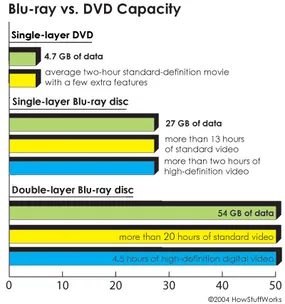
A single-sided standard DVD holds 4.7 GB of data. That is enough space for a two-hour movie in standard definition. You might squeeze in a few extras. Features. Deleted scenes. Commentary.
High definition changes the math. The image is far clearer. It demands about five times more bandwidth. That means five times the storage. As TVs get sharper and studios push for better quality, consumers need players that can hold more data. Standard discs were hitting a wall.

Blu-ray isn’t just a new disc format. It’s a storage engine designed to handle massive amounts of data. You can record it, store it, and play back high-definition video, digital audio, or computer files. The main selling point? Capacity.
Think about a single-layer Blu-ray. It’s the same physical size as a DVD. But instead of 4.7 GB, it holds up to 27 GB of data. That’s a huge jump.
What does 27 GB mean in real terms?
– You get more than two hours of high-definition video.
– Or about 13 hours of standard definition video.
If you need more space, the double-layer disc steps up the game. It stores up to 50 GB. That’s enough for 4.5 hours of HD content. Or over 20 hours of standard video.
Developers are already looking at discs with even higher capacities. The technology isn’t standing still.
How Blu-ray Stores Data
Before we dive into the technical construction, it helps to understand why the capacity is so much higher than a DVD. The answer lies in the laser and the lens.
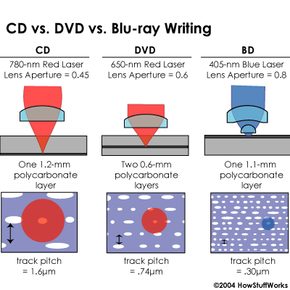
DVDs use a red laser with a wavelength of 650 nanometers. Blu-ray uses a blue-violet laser. The wavelength is shorter—around 405 nanometers.
A shorter wavelength allows the laser to focus on a smaller spot on the disc. Smaller spots mean smaller pits and lands. Smaller features mean you can pack more data into the same physical space.
The lens also has a higher numerical aperture. This further tightens the focus. It’s physics doing the heavy lifting.
The Layer Structure
A standard DVD has one reflective layer. A DVD-R or DVD+R has a single recording layer. Blu-ray discs can have up to two layers, and potentially more in future iterations.
The first layer is semi-transparent. The laser reads through it to reach the second layer. This is why a double-layer disc holds nearly double the data of a single-layer one.
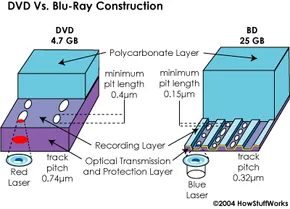
The data is stored in a spiral track. The track pitch—the distance between adjacent tracks—is tighter on a Blu-ray disc. It’s 0.32 micrometers. A DVD’s track pitch is 0.74 micrometers. Tighter tracks mean more data.
Why This Matters for Users
You don’t need to know the nanometer math to benefit from this. You just need to know that one disc can hold a full season of a TV show in HD. Or a high-bitrate movie without compression artifacts.
For software distribution, it means large game installs or professional video projects fit on a single medium. No more juggling multiple discs.
Comparison with DVDs
The difference between Blu-ray and DVD is stark.
| Feature | DVD | Blu-ray |
|---|---|---|
| Laser Wavelength | 650 nm (Red) | 405 nm (Blue-Violet) |
| Single-Layer Capacity | 4.7 GB | 25 GB (often cited as ~23 GB usable) |
| Dual-Layer Capacity | 8.5 GB | 50 GB |
| **Track |

Internet Integration and User Control
Blu-ray isn’t just about storage. The format introduced a new layer of interactivity that standard DVDs never offered. You don’t just watch. You connect to the Internet and pull down subtitles or bonus features on the fly.
The user experience shifts from passive viewing to active management. You can record high-definition television (HDTV) without losing quality. It’s not a compressed mess. You can also instantly skip to any spot on the disc. No more waiting for the laser to seek.
Features like recording one program while watching another on the disc became standard. Playlists are easy to create. You can edit or reorder programs recorded directly onto the disc. The drive helps you out by automatically searching for an empty space so you don’t overwrite a movie you love.
The Physics of the Blue Laser
How does it fit so much data? Discs store video and audio in pits —spiral grooves running from the center to the edge. A laser reads the other side—the bumps. More data means smaller pits. Smaller pits need a more precise laser.
Old DVDs use a red laser. Blu-ray uses a blue laser. Hence the name.
The blue light has a shorter wavelength of 405 nanometers. Red lasers sit at 650 nanometers. That shorter wavelength lets the beam focus tighter. It reads pits that are just 0.15 microns (µm) long. That’s more than half the size of DVD pits.
Blu-ray also tightened the track pitch from 0.74 microns to 0.32 microns. Smaller pits. Tighter tracks. A single-layer Blu-ray disc holds over 25 GB. That’s five times the space of a DVD.
Engineering Around Disc Tilt
The discs look similar. Both are 1.2 millimeters thick. But the internal structure is different.
DVDs sandwich data between two polycarbonate layers. Each layer is 0.6 mm thick. This causes a problem called birefringence. The laser light refracts into two separate beams. If it splits too wide, the disc becomes unreadable.
A tilted surface causes disc tilt. The laser beam distorts. These issues make DVD manufacturing complex. Blu-ray had to solve them differently to handle higher data density.
We’ll see exactly how the format overcomes these physical obstacles next.
Why “Blu-ray” and Not “Blue-ray”
The name comes from the blue laser and the optical ray. But why drop the “e”?
Manufacturers left the “e” out of “blue” intentionally. An everyday word like “blue” cannot be trademarked. They needed a unique name. “Blu-ray” stuck.

Why Blu-ray Discs Don’t Suffer from DVD’s Birefringence Issues
The core engineering difference between Blu-ray and DVD isn’t just about lasers. It’s about physics and where you put the data. Traditional DVDs sandwich the recording layer between two 0.6-mm polycarbonate layers. If you’ve ever tried to read a warped DVD, you know the issue. That thickness causes birefringence—a distortion of light that makes the laser beam scatter. The data becomes unreadable.
Blu-ray flips this model. It places the data on top of a single 1.1-mm-thick polycarbonate layer. This isn’t arbitrary. It prevents birefringence entirely. But it does something else too. It moves the recording layer closer to the objective lens of the reading mechanism.
“Having the data on top prevents birefringence and therefore prevents readability problems.”
This proximity virtually eliminates disc tilt issues. The laser doesn’t have to travel through as much material to hit the data. The result is a cleaner signal. No more skipping. No more reading errors caused by minor physical imperfections in the disc’s structure.
The Manufacturing Cost Paradox
Here is where it gets interesting. You might assume that a more complex design means higher production costs. But Blu-ray’s single-layer approach actually saves money during the molding phase.
DVD manufacturing is a delicate dance. You inject mold two separate 0.6-mm discs. Then you glue them together. The recording layer sits in the middle. This process requires extreme precision. Any slight misalignment or stress in the plastic can induce birefringence. It’s slow. It’s finicky. It’s expensive.
Blu-ray simplifies the chain. You only mold one 1.1-mm disc. That’s it. One step instead of two. No gluing. No sandwiching. The injection molding process is faster. It’s more stable. The cost savings from this streamlined production are significant.
Balancing Protection with Price
Of course, there’s a trade-off. Because the data layer is now exposed closer to the surface, it needs protection. A hard coating is applied to the outside of the disc. This shields the data from scratches and fingerprints. It’s a necessary addition. Without it, the disc would be unusable in days.
Does this extra coating make Blu-ray discs more expensive to make than DVDs? No. The savings from the simplified injection molding process offset the cost of the protective layer. The end result is a disc that costs no more to manufacture than a standard DVD.
This is why Blu-ray could compete on price from day one. It wasn’t just about better video quality. It was about a smarter manufacturing design. The thicker substrate isn’t a drawback. It’s the foundation of both better performance and lower production costs. The tech works because it respects the limits of light. And the business model works because it respects the limits of the budget.


The speed difference is the first thing that hits you. Blu-ray data transfer rate clocks in at 36 Mbps. Compare that to the 10 Mbps limit of standard DVDs. It is not just a marginal upgrade. It is a generational leap. You can fit 25 GB of data onto a single disc. That is enough for a feature-length film in high definition, recorded in just over ninety minutes.
On Guard
Security was never an afterthought for Blu-ray. It is built into the hardware. Current DVDs are notoriously easy to copy. Blu-ray discs come equipped with a secure encryption system. This is not just a password. It involves a unique ID embedded in the disc structure. The goal is simple. Protect against video piracy and copyright infringement. Studios needed a way to stop the “digital” copying that plagued the DVD era. Blu-ray was their answer.
Formats
The architecture of the format is where things get messy. Or flexible. Depending on who you ask.
DVDs and CDs started life as read-only media. They only added recordable and re-writable options years later. Blu-ray skipped that phase. It was designed from the ground up with multiple formats in mind. This is why you see so many acronyms when you buy blank discs.
- BD-ROM is for read-only content. Think pre-recorded movies. It is the digital equivalent of a pressed CD.
- BD-R stands for recordable. This is for PC data storage. Once you write to it, it is done. You cannot erase it.
- BD-RW is rewritable. Also for PC data storage. You can overwrite this disc multiple times.
- BD-RE is another rewritable format. But this one is specifically optimized for HDTV recording. If you are using a Blu-ray recorder to catch live TV, this is the disc you need.
“Unlike DVDs and CDs, which started with read-only formats and only later added recordable and re-writable formats, Blu-ray is initially designed in several different formats.”
The variety is confusing. But it allows for specialization. You do not use a BD-RE for storing family photos. You use a BD-R. You do not use a BD-ROM to record a game. You need the flexibility.
Blu-ray Competitors
The format war is far from over. We will look at some of Blu-ray’s competitors in the next section.


Manufacturers wanted Blu-ray to swallow the DVD market whole. They hoped for a clean sweep. But the reality was messier. JVC saw the transition and built a bridge. They created a Blu-ray/DVD combo disc. This hybrid held about 33.5 GB. It let studios release video in both old and new formats on one physical disc. It was a compromise for a divided audience.
But Blu-ray wasn’t the only game in town. The market was crowded. Other formats were fighting for a slice of the DVD pie.
The HD-DVD Contender
Enter HD-DVD. Also known as AOD (Advanced Optical Disc). Toshiba and NEC developed this rival standard. It was actually in the works before regular DVD. Real development only kicked off in 2003.
The main selling point was cost. HD-DVD used the same basic format as traditional DVDs. This meant manufacturers could use existing equipment. That saved money. It kept production lines running without massive capital expenditure.
Storage capacity was competitive. A single-layer rewritable HD-DVD held 15 GB. Double-layer went up to 30 GB. Triple-layer discs could store 45 GB. Compare that to Blu-ray’s 27 GB and 50 GB limits. Read-only HD-DVDs held slightly less. The interactive capabilities matched Blu-ray’s HDi standard too. If you want to dig deeper into the tech, look up How HD-DVD Works.
Other Players in the Ring
Blu-ray and HD-DVD dominated the headlines. But the field was wider. Warner Bros. Pictures developed HD-DVD-9. This system used higher compression. It squeezed about two hours of high-definition video onto a standard DVD. It was a clever hack for a transitional period.
Taiwan contributed Forward Versatile Disc (FVD). This was an upgraded DVD. It offered more storage. Single-sided discs held 5.4 GB. Double-sided versions reached 9.8 GB. China introduced the Enhanced Video Disc (EVD). Another high-definition contender. Another format to confuse consumers.
Professional Applications
The blue laser tech wasn’t just for movies. Sony developed professional versions. They created XDCAM for broadcasters and AV studios. They also made ProData (Professional Disc for Data). This was for commercial data storage. Think server backups. It kept the high-density storage market active beyond home theater.
The Future Was Bigger
25 GB or 50 GB seemed like a lot at the time. But the future promised more. Pioneer was already looking ahead. They were developing an optical disc with 500 GB of capacity. That would blow away most PC hard drives.
How? Ultraviolet lasers. The wavelength is even shorter than blue. Shorter wavelength means smaller data pits. Smaller pits mean more data. The storage war had only just begun.
Frequently Answered Questions About Blu Ray
What is Blu-ray Disc?
Blu-ray Disc is a high-capacity optical disc format. It stores high-definition video, audio, and computer data. A disc can hold up to 256GB of data.
Are Blu-ray discs obsolete?
No. They are far from obsolete. Physical media still has a place.
What is the difference between DVD & Blu-ray?
The main difference is resolution. Blu-ray offers higher resolution than DVD.
Lots More Information
Related HowStuffWorks Articles
-
How DVDs Work
-
How HD-DVD Works
-
How CDs Work
-
How Digital Television Works
-
How HDTV Works
-
How Flexplay DVDs Work
-
How Home Theater Works
-
How Video Formatting Works
-
What is the Difference Between DVD-Audio and CDs?
More Great Links
-
Blu-ray.com
-
Blu-ray Disc Association
-
Blu-ray Disc FAQ
-
BBC News: DVDs could hold ‘100 times more’ – Sept. 28, 2004
-
CNET News: Blu-ray Burns for Interactive Content – Aug. 17, 2004
Sources
-
Sony to deliver Blu-ray titles June 20, CNET News, June 13, 2006
-
Arnold, Thomas K. “Techies Improve on DVDs,” USA Today, April 19, 2004, page B.06.
-
Background of Blu-ray Disc Technology, Blu-ray disc.
-
“BDF Announce Next Steps in Establishing Blu-ray Disc as the Next Generation Optical Disc Format.” BDF Press Release. January 8, 2004.
-
Blue Laser HD DVD Formats & Technology, Disctronics.com.
-
“Blu-ray Disc to Deliver Five Times Disc Capacity of DVD Discs with Comparable Costs Per Disc.” BDF Press Release. Blu-ray Disc, March 29, 2004.
-
Blu-ray FAQ, Blu-ray.com
-
Frauenheim, Ed. Standards Battle Could Shoot Both Sides in Foot, CNET news.com, August 17, 2004.
-
Labriola, Don. “Blue Lasers Boost DVD Capacity,” PC Magazine, August 2004, page 30.
-
Large Capacity Optical Disc Video Recording Format “Blu-ray” Disc” Established, Blu-ray Disc Press Release, February 19, 2002.
-
Parisi, Paula. “The Great DVD Debate,” Hollywood Reporter, April 13, 2004, page S13.
-
Shaw, Jake. Matsushita Unveils Blu-ray DVD Recorder, NewsFactor Innovation, June 30, 2004.
-
Shim, Richard. Blu-ray Burns for Interactive Content, CNET News.com, August 17, 2004.
-
Shim, Richard. Sony Shines Light on Blu-ray DVD Plans, CNET News.com, March 2003.
-
Smith, Tony. DVD Forum Punts Blue Laser HD-DVD, The Register, April 15, 2004.
-
What is Blu-ray?, Blu-ray.com