




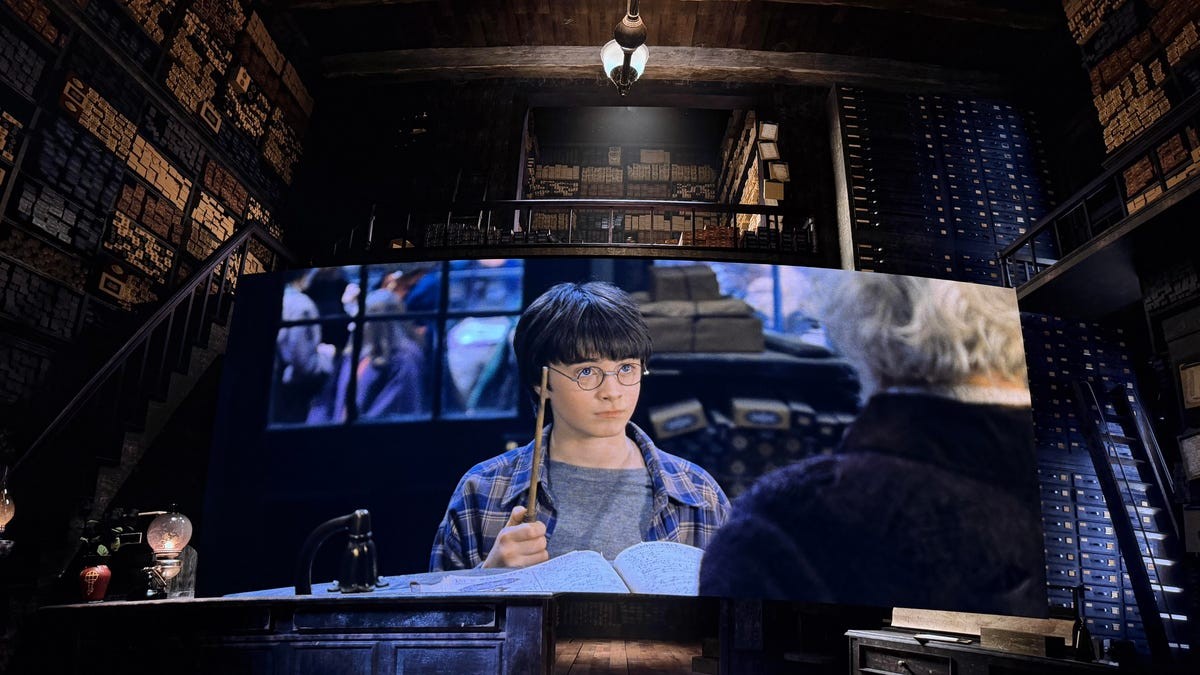
The traditional movie-going experience is undergoing a subtle but significant evolution. It is no longer just about watching a story unfold on a flat rectangle; it is about stepping inside the narrative without the isolation of a virtual reality headset. At Cosm, an entertainment venue with locations in Los Angeles, Dallas, and Atlanta, this concept has been realized through a format called Shared Reality.
Recently, the first film in the Harry Potter saga, Harry Potter and the Sorcerer’s Stone, debuted in this format. The result is not merely a screening, but a transportive experience that leverages an 87-foot LED dome to blend traditional cinema with expansive 3D environments.
The Mechanics of Immersion
The core innovation of Shared Reality lies in its balance between immersion and preservation. Unlike The Sphere in Las Vegas, which often fills the entire visual field with panoramic imagery, Cosm’s approach keeps the original film intact in a central window. Surrounding this focal point, however, are computer-generated visuals that extend the scene into the physical space of the dome.
During the opening sequence on Privet Drive, the beige suburban homes and streetlamps stretch outward, creating a sense of infinite space. When Harry enters Diagon Alley, towering shops rise around the audience, mirroring his own sense of wonder. In the Hogwarts Great Hall, hundreds of flickering candles appear to float overhead, placing viewers directly among the first-year students.
This technique addresses a critical gap in current entertainment technology. While VR headsets offer deep immersion, they often suffer from disorientation, physical discomfort, and—most importantly—social isolation. Shared Reality eliminates the need for hardware, allowing audiences to laugh, gasp, and react together, preserving the communal spirit of the cinema.
“That communal aspect, that shared element, is really critical to what distinguishes Cosm in this market,” said Devin Poolman, Cosm’s chief product and technology officer. “We want to make you feel like you’re there and really transport you as part of the experience.”
Balancing Art and Technology
Creating this experience required a delicate artistic balance. The goal was to enhance the film without overriding it. Too much visual noise would distract from the narrative; too little would fail to justify the unique format.
The production team, led by Cosm in collaboration with Little Cinema and MakeMake Entertainment, spent approximately a year developing the Sorcerer’s Stone adaptation. They utilized traditional 3D visual effects workflows, moving from shot lists to high-fidelity renders at 12K resolution to ensure clarity on the massive display.
Key design choices included:
* Static Environments: Scenes like the Gryffindor common room or Potions classroom feature ambient details—glowing lamps, bubbling cauldrons—that create atmosphere without demanding constant attention.
* Dynamic Peaks: High-energy moments, such as the journey on the Hogwarts Express or the wizard’s chess match, feature dramatic 3D extensions, like giant chess pieces looming overhead, to heighten excitement.
Kirk Shintani, creative director at MakeMake, emphasized that the film remains the “hero” of the experience. “We’re trying to accentuate a moment and not override what the film is trying to accomplish,” Shintani explained. “What we’re doing is we’re trying to put you guys in that moment so you can feel it a little bit more.”
Why Harry Potter?
The choice of Harry Potter and the Sorcerer’s Stone as the third title in the Shared Reality lineup was strategic. The franchise possesses a visually rich canon and a deeply passionate global fan base, making it an ideal candidate for an experience that relies on emotional connection and visual wonder.
Partnering with Warner Bros., the studio behind the original films, allowed the team to gauge the best ways to present iconic scenes while respecting the source material. The result is a hybrid viewing format that appeals both to longtime fans seeking a new way to engage with the wizarding world and to newcomers experiencing the story for the first time.
The Future of Shared Viewing
As Shared Reality launches publicly on May 7, it raises questions about the future of theatrical exhibition. Will this become a standard for major franchises? Could we see more Harry Potter films adapted in this style? While the long-term strategy remains unclear, the success of this experiment suggests that audiences are eager for cinema experiences that are both technologically advanced and socially connected.
In summary, Cosm’s Shared Reality offers a compelling middle ground in entertainment: it delivers the immersion of VR with the social warmth of traditional cinema, proving that technology can enhance storytelling without isolating the viewer.