





If you live in an established suburb, you see them everywhere. Those unassuming enclosures sit on the lawn between the house and the sidewalk. They are not garbage. They aren’t utility meters for water or gas. These are connection boxes for telephone services.
If your community relies on underground infrastructure instead of overhead wires strung on wooden poles, these boxes become visible nodes of a massive, hidden network. In the southeastern United States, you may find standard concrete or plastic enclosures that are about 2-3 feet tall. It is about 8 inches square. To the casual viewer, it looks like garbage. This is an important base for phone company technicians.
Hidden copper network
This is the true story of how cell phone signals reach your doorstep. It starts with thick, heavy cables buried underground. This isn’t a single wire. This is a bundle containing dozens of individual pairs. A typical cable holds 25 pairs of copper wires. Or 50. More depending on the frequency.
These pairs travel from the local center through miles of conduit to reach the box. This box is just an exit ramp. Here, thick underground cables come to the surface so a technician can splice into it.
Building Out the Network
When a developer breaks ground on a new plot, the process can be mechanical and repetitive. The crew arrives. They dig ditches. They lay the main trunk line. Then they place these boxes at strategic intervals.
Why? Copper wires do not stop. It must branch. It has to reach every single lot. This box allows technicians to tap into the main 50-pair cable and connect smaller individual pairs to specific addresses.
You are looking at the physical manifestation of connectivity. Without these boxes, your network becomes just one unbroken wire. With them, it becomes a distributable grid. You can add houses. You can remove a line. The entire road does not need to be dug up to repair the cut.
The Cost of Conduit
Installing underground cables is much more expensive than overhead cables. You have to dig a trench. Different materials must be used. You have to pay for work that doesn’t involve pole climbing.
But it looks cleaner. It withstands storms well. It creates a strange landscape where the same boxes are repeated. There is another every few houses. It’s a green cover. Heavy metal frame. Seals prevent moisture from entering the fragile copper connections inside.
It is visible infrastructure. It’s not a flashy method. But somehow I am reminded that phones, internet and voice are not magic. They are physical objects. copper. Concrete. steel. Buried in the ground, waiting for someone to open the box and make a connection.
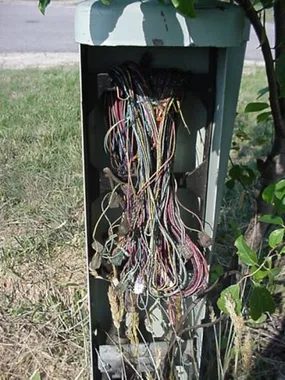
From the delivery point to the main feeder
The junction box you just saw is the end of some houses. You can clearly see what is happening here. The installer disconnects the main cable. Single pairs of wires were found inside. These little clear plastic parts allow you to snap them right into two or three pairs. This causes a drop underground from the box to the door.
It’s not always so pretty. In some cases, instead of connecting wires directly, you may find metal or plastic plates with wiring blocks. The logic is the same. Just go to the main web. But this raises the obvious question:
If this box can only be used in two or three houses, where does the heavy 25 or 50 pair cable come from?
Find a preferred distribution point
If you walk around your neighborhood looking for larger infrastructure, you’ll likely find larger fences. It looks different than a small junction box. The main power cable comes out here.
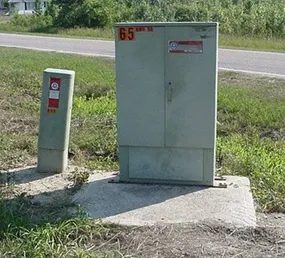
Structure of road connections
The height of the box you see is about 1.5 meters. Maybe a little more. A thick cable containing hundreds of wire pairs runs past it. The main thread branches here. This connector becomes one or more small 25-pair or 50-pair cables.
Inside the metal case is a large embossed panel. This is where the work is done. A telephone company technician connects the wires manually. Take each pair of the small branch cable and cut it to the corresponding pair of the large trunk. This is a physical bridge. Route specific signals to a wider network.
Bigger cables didn’t just appear out of nowhere. It usually starts with a box like this:
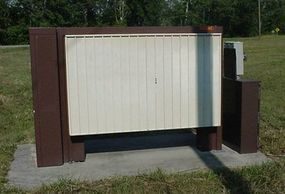
Power scaling and signal compression
At nearly 6 feet tall and 12 feet wide, this massive enclosure is more than just a passive connection point. You can tell it’s active by the power meter on the right. Unlike previous boxes that only deal with physical connectors, this unit pumping electricity into digitizers.
The logic here is simple efficiency. Individual pairs from each house in the neighborhood are connected directly to these digitizers. This setup allows the system to compress all local telephone traffic. Instead of using a separate copper line for each callback to the central office, the digitizers break down the multiplexed lines into separate pairs.
This means that the infrastructure can carry more voice channels using smaller physical circuits. These larger lines feeding the box can be T1 or T3 lines. They run on the streets in the form of copper wire, fiber optic or coaxial cables and carry large amounts of data.
Switching Destination
Eventually, compressed and multiplexed lines are not going away. They arrive at a switch. This is the magic of routing. The hardware looks like this:

Windowless Data Fortress
This is a box. About 50 feet wide. No glass. No views. Only concrete, steel and the quiet hum of servers working overtime. It might not seem like it from the outside, but this windowless monolith is actually where much of our digital life happens.
Think about it. The data that drives search results, social messages and banking applications resides in rooms that look more like bunkers than workplaces. Security is more than just a firewall here. It’s about physical barriers. If you can’t get in, you can’t hack in. Literally.
“If you can’t get in, you can’t hack in. Literally.”
This is the reality of modern infrastructure. We talk about cloud services like it’s ethereal, but the cloud has a postal code. Zip codes usually lead to a place with heavy doors and no windows.
Why Your Phone Choices Are Changing
When we talk about infrastructure, we’re talking about the hardware in your pocket. You are at a crossroads. The market is full of options, and even if the differences are small, they can be expensive.
Consumer Guide Products has been tracking these changes for years. It’s not just about listing specifications. they compare real-world performance. When you buy a new phone, you’re buying more than just a screen. You end up buying a gateway to that windowless building.
Consider trade-offs.
– Battery life: Will it last the whole flight? Do I still need a charger?
– Processing power: Can AI tasks be handled locally or are they dependent on the cloud?
– Privacy controls: Who owns the information you create?
The “smart” choices aren’t always the flashiest ones. Sometimes it’s the device with the best encryption. Sometimes I’m the type that doesn’t call home every five minutes.
Convenience costs
We trade privacy for convenience daily. We accept terms of service we don’t read. We connect to Wi-Fi networks we don’t trust. However, the infrastructure behind these options is getting stricter.
That windowless building? It is smaller, denser and more secure. As AI models grow, the hardware requirements shift. If you have a powerful mobile phone, you don’t need a large server farm. The edge is moving in.
So when reading reviews, don’t just focus on megapixels. Look at the architecture. Check security protocols. See where your data goes when the screen goes dark.
The next time you swipe up, remember the box. The one with no windows. The one that knows everything.