



Let’s cut through the jargon. A microphone is just a device that takes sound waves and turns them into electricity. It’s not magic. It’s physics. The electrical signal it produces mimics the shape of the sound wave hitting it. Simple enough.
For decades, the telephone transmitter dominated the market. If you made a mic, you were likely making one for a landline phone. That volume drove the industry. But those days are mostly over. Today, when people say “microphone,” they rarely mean the thing inside a wall jack. They mean something else.
The real action is elsewhere.
Where are microphones actually used?
You won’t find the bulk of modern mic sales in telephony anymore. The heavy hitters are different.
Hearing aids rely on tiny, specialized mics to amplify life’s noise. Sound-recording systems need them. We’re talking magnetic tape archives and modern digital recorders. Dictating machines still exist, surprisingly. And public-address systems? They need mics to push voice over crowds.
But there’s a bigger shift happening in communications.
The push for quality and hands-free freedom
Why are engineers moving away from standard telephone transmitters? Two reasons.
First, quality. Old-school phone mics are limited. They cut off frequencies. They distort. Modern microphones offer better response. They sound closer to reality. For radio broadcasts or high-end wire communications, that clarity matters.
Second, hands-free operation. You don’t want to hold a receiver. You want to walk around. You want to drive. The mic stays put. Your voice carries over.
This isn’t just about better audio. It’s about mobility. It’s about freedom from the cord.
The telephone transmitter is a relic. A necessary one, perhaps. But not the future. The future is in the hearing aid. The recording studio. The conference room. The car.
And it’s getting smaller. Better. Louder.
But how small can it get before the physics break down? We’ll see.

How sound waves become electricity
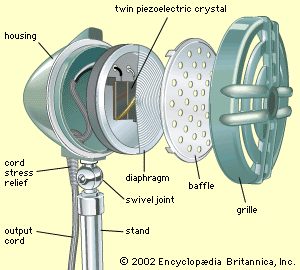
The magic inside a microphone happens in two steps that occur so fast you can barely see them. First, sound waves—essentially pressure changes in the air—hit a thin, flexible surface called the diaphragm. This diaphragm vibrates back and forth, mimicking the movement of the air particles that struck it.
Second, that physical motion gets translated into an electrical signal. It’s not one-size-fits-all though. The way the microphone converts that movement depends entirely on its design.
Take a carbon microphone. When the diaphragm moves, it compresses carbon granules. This changes the electrical resistance in the circuit. A condenser or capacitor microphone uses a different trick. The diaphragm acts as one plate of a capacitor. As it moves, the distance to the other plate changes, altering the electrostatic capacitance.
Dynamic and ribbon microphones rely on magnetism. Here, the diaphragm is attached to a coil or a thin ribbon of metal. When this conductor moves through a magnetic field, it generates an electric current. Crystal microphones use piezoelectric materials. The mechanical stress of the diaphragm twisting or bending creates a voltage in the crystal.
Finding the right angle
“By proper design, a microphone may be given directional characteristics so that it will pick up sound primarily from a single direction (unidirectional), from two directions (bidirectional), or more or less uniformly from all directions (omnidirectional).”
This isn’t just about capturing sound. It’s about controlling where that sound comes from. Good design allows engineers to give a microphone specific directional traits.
- Unidirectional : Picks up sound primarily from one direction. This is common for live vocals or interviews where you want to isolate the speaker from background noise.
- Bidirectional : Captures sound from two opposite directions. Useful for face-to-face interviews.
- Omnidirectional : Picks up sound uniformly from all directions. It captures the room’s ambience but offers less isolation.
The goal is always the same. Every variation in the diaphragm’s movement produces a corresponding variation in the electric output. The complexity lies in how that movement is harvested. Whether through resistance, capacitance, magnetism, or piezoelectricity. The result is the same. A signal that mirrors the original sound wave.