

Standard digital audio is based on a simple premise: capturing the waveform, storing the mathematical information, and recreating the waveform. In theory, it’s clean. In reality, this is a series of transformations that cause noise, distortion, and phase errors.
To understand why 1-bit Digital-to-Analog Converter (DAC) exist, you need to understand the basic mechanics of digital recording. The goal is high fidelity. We want the reproduction to be as close as possible to the original signal. perfect reproduction is also required. No matter how many times you’ve listened to it, it should sound the same every time you hit play.
Digital audio achieves this by eliminating analog waves entirely. Instead, it converts the continuous audio voltage into a digital stream. An analog-to-digital converter (ADC) handles this capture. A Digital-to-Analog Converter (DAC) converts these numbers into speaker voltages.
This process is determined by two variables that are controlled during sampling.
- Sampling rate: The number of waveform snapshots taken per second.
- Sampling precision: How many different levels (quantization steps) there are between minimum and maximum volume.
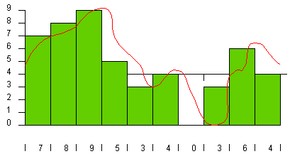
Consider a hypothetical setup with a sampling frequency of 1000 Hz and a resolution of 10 steps.
Every millisecond, the ADC takes the current voltage of the waveform and rounds it to the nearest integer between 0 and 9. These integers are digital representation. The DAC tries to reconstruct the curves when playing them. The result is a step-by-step approximation of the original wave.
This step may introduce artifacts. There is noise. Distortion happens.
A 1-bit DAC eliminates this complexity. It is not intended to be an exact representation. I don’t try to do too many things at once. Use only two modes: on or off. Is it high or low? 1 or zero.
1-bit converters use techniques called oversampling and noise shaping by increasing the sampling rate to millions of times the audio frequency. It moves the quantization noise from the audible range to the ultrasonic spectrum, where it can be easily filtered out.
The result is a waveform that is completely different from the staggered blue line seen in traditional DACs. This is a raw stream of high-frequency pulses that, when smoothed by the speaker, produces a smooth analog sound.
This approach is often referred to as Direct Stream Digital (DSD). It was developed by Sony and Philips for the Super Audio CD format. It’s not just a way of storing data differently. It’s about a different philosophy on how to deal with noise.
Traditional multi-bit DACs (such as 16-bit or 24-bit PCM) struggle with linearity. Small errors in the digital code led to harmonic distortion. A 1-bit DAC does not have such linearity issues. It is either fully on or fully off. “Almost” is not an option.
However, this simplicity comes with trade-offs. The data speed is huge. A standard CD audio file takes about 10 MB per minute. DSD files of the same quality are over 400 MB. That’s why it’s not in Spotify or Apple Music’s default settings. It is very heavy. It’s complex to process.
However, audiophiles consider the characteristics of the sound in the following way.
Let’s take a look at the waveform comparison. The blue line looks messy compared to the original red line. Details disappear. The reproductions are uneven, inaccurate and have obvious flaws. This is a true sampling error. This is the difference between what the analog world actually sounds like and what digital systems record. You can’t ignore it. This problem must be solved by increasing two factors: sampling frequency and accuracy.
Fix accuracy gap
Previous attempts were too rough. For better results, the speed and accuracy should be doubled. This means that the number of measurements per second is doubled and the number of steps available for measurement is doubled.
In this updated scenario, the system captures the amplitude at 20 gradations. This is done at a rate of 2,000 samples per second. This is a significant step up from lower-fidelity attempt. The blue line is now more closely integrated with the red line. The jagged edges become smoother. The expression becomes closer to reality.
Higher sample rate and higher bit depth reduce errors between analog source and digital copy.
Why this is important for everyday audio
You might think this is just a theory. This is not true. Every time you play a song or record a voice memo, your device is fighting the same battle. If the sampling rate is too low, the sound will be distorted. High frequencies are lost. The music sounds muddy or metallic. Accuracy is also important. Without enough gradients (bits), the quiet details fade into silence or noise.
By doubling the speed to 2,000 samples per second, you can capture more waveforms. Increasing the level to 20 allows finer volume separation. The result is a signal that feels more like a live performance. It’s not perfect yet. But it’s closer.
The red line is still ideal. The blue line is the best approximation. Using more data points and more precise steps improves the fit. The difference is getting smaller. But unless you have infinite resources, it never truly disappears. That’s the compromise. More data requires more storage and processing power. Less data saves space, but reduces accuracy. You have to choose where to draw the line.
Interesting things happen when you increase the sampling rate and resolution. Looking at the chart, the speed and accuracy have doubled to 40 levels at 4,000 samples per second. Better fidelity. The output waveform starts to look like the original signal. For CD, the standard is 44,100 samples per second (44.1 KHz) with 65,536 gradations (16 bits). At this level, the DAC output matches the waveform so closely that it sounds “perfect” to the human ear.
But hardware can get expensive quickly.
Traditional DACs use different resistors for each bit. A 4-bit DAC requires four resistors in parallel. Moving to 16-bit or 32-bit requires enough resistance to handle 65,536 gradations. Matching these values exactly is a nightmare for manufacturers.
The One-bit dual D/A converters solves this problem by bypassing the resistor bank entirely. Parallel resistors are not used. Instead, it creates a modulated signal based on the digital data. This process is based on noise shaping.
Why noise shaping works
Human ears have their limits. We are most sensitive to noise around 5 kHz. Barely noticeable up to 20 KHz. Noise shaping pushes quantization errors (noise) to higher frequencies, making them inaudible. DACs produce stable analog signals without the need for hundreds of precision components.
Role of delta-sigma modulator
The delta-sigma modulator is the heart of this converter. Takes a binary signal (1s and 0s) from a CD and converts it into a pulse train. This is more than just streaming. The pulse train contains the average energy change of each sample.
Burst waveforms are clocked at a very high frequency. Above 44.1kHz sampling rate. This oversampling is important. Next, a low-pass filter removes the time domain information. Just returns the average energy of the pulse train. The result is fed to the DAC and an analog signal is sent.
How the circuit breaks down
The delta-sigma circuit has two different parts.
- Delta monitors the incoming digital signal and the outgoing pulse train. Based on the difference between the two, calculate the error signal.
- Sigma summarizes the result of this error signal. This sum will be sent to the low-pass filter.
The low-pass filter uses the error signal to average the analog output. Minute adjustments compensate for the gaps between the binary input and the pulse train output. The result is smooth.
Results
Get high-quality sound with simple hardware. No need to match the 65,536 resistors. The noise gets pushed out of the audible range. The listener hears music, not math.
This approach changes the way audio equipment is built. Move complexity from analog precision to digital processing. The trade-off is computing power. But for most listeners, the trade-off is worth it.
The technology behind these converters is very intensive. Detailed diagrams and instructions are available online. If you want to learn more, check out Delta Sigma Modulation and Adaptive Delta Modulation. The math is complicated. The result is simple. The sound is clear.
Still wondering how this affects your everyday hearing? The difference between cheap DACs and high-end DACs is often their ability to handle noise shaping. It’s not just bits and samples. It’s about how machines hide their flaws.