



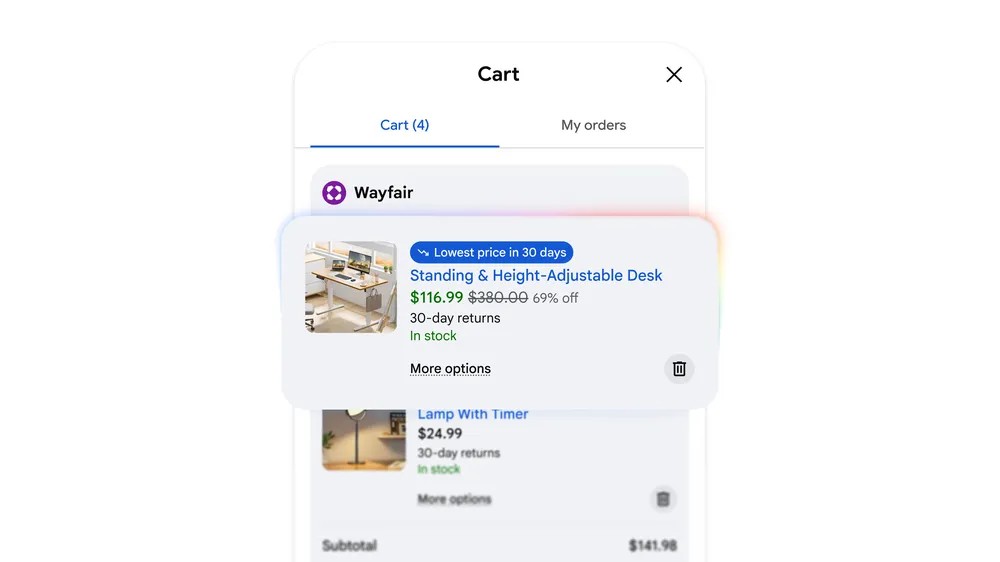
Universal Cart. That’s the new name for Google’s attempt to herd every product you’ve ever eye-balled into a single digital basket.
Announced Tuesday at Google I/O, the feature is more than just a container for items. It is an agentic hub. Google calls it a push to move AI from passive recommendation engines to active participants in your wallet.
Active is the operative word here.
With Universal Cart, the friction between searching and buying evaporates. You can stash products in your cart from Search, chat with Gemini about specs, watch a review on YouTube, or find an old email with a receipt in Gmail. The cart catches them all.
It doesn’t just hold things, though. It watches.
“The cart tracks deals, monitors price drops,” Google explained. “It surfaces price history.”
Stock alerts happen too. If that last pair of sneakers sells out, Universal Cart pings you when they’re back. It understands that shopping is messy, spanning devices, days, and retailers.
AI steps in to clean up the mess, sometimes literally.
Building a PC? Add a processor and a motherboard from two different stores. The AI checks the specs. It might tell you, politely but firmly, that the chip won’t fit the board. It even suggests alternatives. No more returning mismatched hardware.
Rewards get a boost too. Because Universal Cart rides on Google Wallet, it digs for hidden savings. It stretches your points further, if you bother to use them.
Checkout options are flexible, thanks to the Universal Commerce Protocol, or UCP.
You can check out through Google directly, provided the merchant participates. Or, you dump the cart back into the merchant’s site. The ball stays in your court until you say otherwise.
Launch is immediate. It’s live in the U.S. today. Gemini app gets the treatment this summer. YouTube and Gmail? Coming later.
But UCP isn’t just staying in America.
Hotels and food delivery are entering the protocol fold. Canada and Australia join the U.S. next, with the U.K. following behind.
Who pays? That’s the real story
Universal Cart is flashy, sure. But AP2 — Agent Payments Protocol — is where the power shifts.
Google detailed a system where AI agents don’t just recommend. They buy.
Securely, obviously. But buy.
Users set guardrails. Spending limits. Preferred brands. Specific products.
The agent waits for the conditions. When a price hits a threshold, or stock aligns, it pulls the trigger. Automatic purchase.
“Users authorize agents to make payments,” the announcement reads.
This terrifies retailers a little. And delights them in equal measure, depending on the angle.
Google gets visibility now. Not just on what you look at, but what you actually buy. That data goldmine flows directly to Mountain View.
AP2 handles the dirty work, though. It encrypts everything.
There’s a transparent link between buyer, merchant, and payment processor. Tamper-proof digital records. An audit trail for disputes, returns, or arguments about whether the shirt was really red or maroon.
Google says it integrates AP2 into its products over the coming months.
It’s a bold move.
AI isn’t just asking “Would you like fries with that?” anymore.
It’s buying them. And deciding if the price was fair enough to swipe the card.