




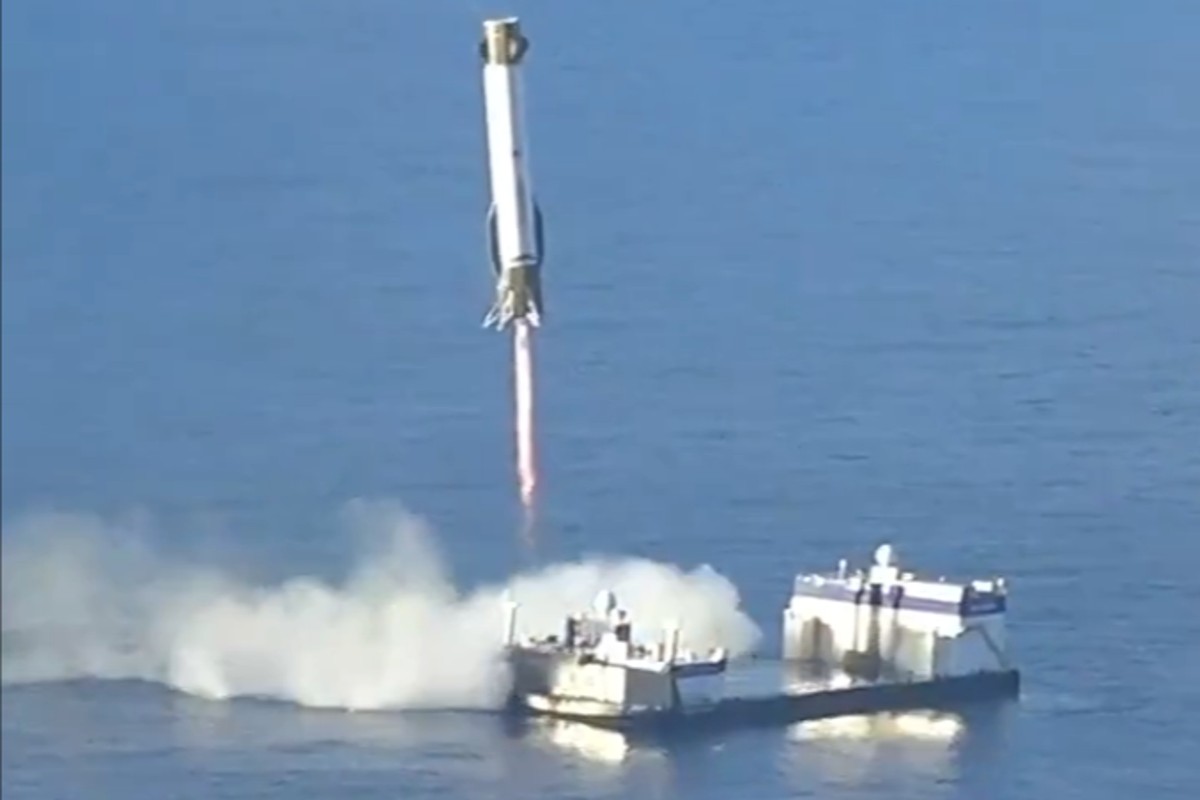
Blue Origin, the aerospace company founded by Jeff Bezos, faced a significant technical setback on Sunday when its New Glenn rocket failed to deliver a critical payload into its intended orbit. While the launch achieved success in rocket reusability, the primary mission objective—deploying a high-capacity satellite—was lost.
The Mission Failure: BlueBird 7 Lost to Deorbit
The mission’s primary goal was to deploy the BlueBird 7 satellite, a massive piece of technology developed by AST SpaceMobile. This satellite is a cornerstone of a planned direct-to-smartphone broadband network designed to provide global connectivity.
According to a statement from AST SpaceMobile, the satellite successfully separated from the New Glenn upper stage and powered on. However, it failed to reach the necessary altitude to maintain its position.
– The Problem: The satellite’s altitude is too low for its onboard thrusters to compensate for atmospheric drag.
– The Outcome: Without sufficient altitude, the satellite cannot sustain operations and will inevitably deorbit and burn up in the atmosphere.
This loss is a blow to AST SpaceMobile’s rollout plans, which had originally aimed for service deployment as early as this year.
A Mixed Result: Reusability Success Amidst Payload Failure
Despite the loss of the satellite, the launch provided a crucial proof of concept for Blue Origin’s heavy-lift capabilities. The mission’s first-stage booster, nicknamed “Never Tell Me The Odds,” successfully completed its flight and performed a controlled landing on a ship in the Atlantic Ocean.
This successful recovery is a vital milestone for Blue Origin as they attempt to bridge the gap between traditional expendable rockets and the highly reusable models pioneered by SpaceX.
The ability to recover and reuse boosters is the primary driver of cost-effective space access; without it, heavy-lift spaceflight remains prohibitively expensive.
The success of the landing drew a rare moment of acknowledgment from SpaceX CEO Elon Musk, who congratulated Bezos on the achievement. Musk highlighted the milestone by contrasting it with SpaceX’s own recent success: the 600th successful landing of a Falcon 9 booster.
The Stakes: NASA’s Artemis Program and Lunar Ambitions
The New Glenn rocket is not just a commercial vehicle; it is a foundational component of Blue Origin’s long-term strategic goals. The rocket is being developed to launch the Blue Moon lander, which is slated to support NASA’s Artemis IV mission in 2028.
Blue Origin officials previously indicated plans to use New Glenn for an uncrewed mission to the Moon involving the Mark 1 Blue Moon lander within the next few months. While the loss of the BlueBird 7 satellite is a setback for commercial telecommunications, it remains unclear how this failure will impact Blue Origin’s aggressive lunar timeline.
Summary
While Blue Origin proved that its New Glenn booster can successfully return to Earth, the mission failed its primary objective by placing a vital communications satellite into an unsustainable orbit. The company must now resolve these orbital injection issues to ensure the success of its upcoming lunar missions and NASA partnerships.