




It pops up everywhere now.
Scrolling through feeds? AI ads.
Searching for shoes? Likely AI-generated visuals.
Watching YouTube? Probably synthetic media in the corner spot.
Google finally put a pin in it. Or rather, a label.
On Thursday, the search giant rolled out a feature designed to tell you exactly when an ad has been cooked up or altered by generative artificial intelligence. No more guessing. You’ll know if what you’re looking at is a photograph of a real person holding a real soda or a synthetic composite generated by code.
Why does knowing how ads were made matter?
Trust is a fragile thing in digital marketing.
When AI handles the heavy lifting for creatives, brands save money. They cut production costs. They access visual choices that used to require a Hollywood budget. It’s efficient.
But efficiency isn’t always honest.
See an ad showing a product in a pristine, impossible environment? Wonder if the model looks exactly like that in reality? That disconnect matters. Consumers get confused when reality gets smoothed over by algorithms.
Google wants to fix that opacity.
The new system aims to provide clear disclosure so viewers can decide what resonates with them.
This isn’t just for fun. It addresses the growing unease about synthetic media cluttering the internet. It helps answer the question: Is this real, or did a machine make it look nice?
Where to find AI disclosure tags
You don’t need special software. Just a phone or laptop with internet.
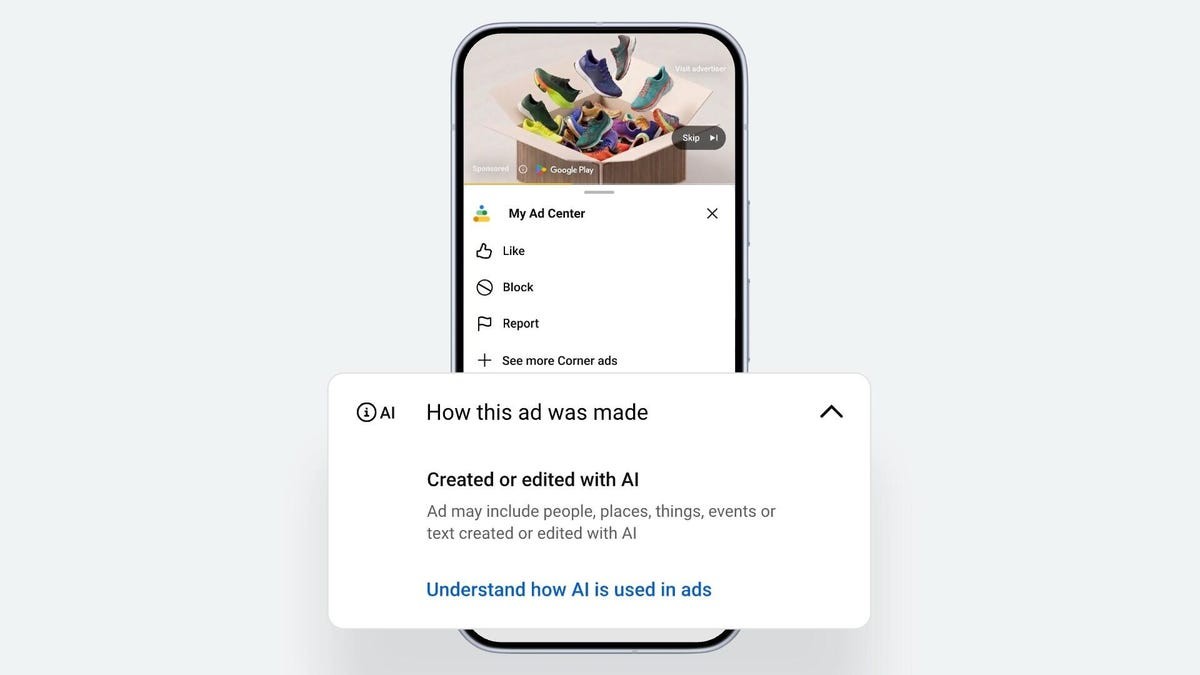
Go to the “My Ad Center” panel. Find an ad. Click the three-dot menu or the little ‘i’ info icon. This works on Search, YouTube, and Discover.
A new section appears.
It is labeled “How this ad was made”.
Inside, it tells you the truth. Did the advertiser use AI to create it? Edit it? The label shows that status clearly. If you use generative AI tools via Google’s platforms, the system automatically surfaces this disclosure. You don’t have to think about it. The label appears by default.
Who is responsible for the labels?
Here is the catch.
If the ad was created on Google’s own platform, the system handles it. It’s automated.
But if the ad comes from somewhere else? Another platform? A third-party tool?
Then the label depends on the advertiser’s honesty.
Google gives them the controls. The advertiser states whether AI was used. That input drives the label that pops up directly on the ad screen. Google does not fact-check this. They won’t send a team to audit the source files of every third-party creative asset.
So, does the system fail here?
Maybe. Or maybe advertisers are more compliant than you think. Local laws play a big role. If your jurisdiction requires AI labeling, that tag shows up regardless of Google’s internal verification process. The onus sits squarely on the marketer to label accurately.
Google made it clear.
Advertisers handle the compliance. They answer for the truth of the tag.